Kaillou

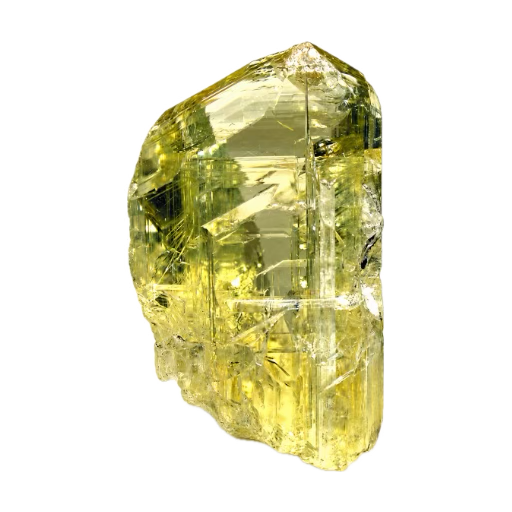
Zoisite
Zoisite is a calcium aluminum silicate found in metamorphic rocks and pegmatites. Its transparent blue to violet variety is the gem tanzanite.
How to identify zoisite
Prismatic crystals with lengthwise grooves and one perfect cleavage, in gray, green, brown, pink or blue-violet. Green massive zoisite is often speckled with red ruby crystals.
Real or fake zoisite: common imitations
- Heat-treated tanzanite
- Almost all tanzanite is heated to turn its brownish crystals blue. This is a normal, accepted treatment.
- Iolite
- A violet-blue stone that looks similar but is lighter. It also changes color with the viewing angle, from violet-blue to pale yellow.
- Glass or synthetic stone
- Glass shows round bubbles. Blue synthetic corundum is harder and lacks the color shift of tanzanite.
How much is zoisite worth?
At average quality, a walnut-sized rough piece (about 47 g) is worth $1 to $4; a 1 kg rough piece, $20 to $43; an egg-sized crystal (about 155 g), $10 to $36.
| Specimen | Ordinary | Average | Fine |
|---|---|---|---|
| Rough piece, walnut-sizedabout 47 g | $1 to $3 | $1 to $4 | $3 to $8 |
| Rough piece, 1 kg | $12 to $25 | $20 to $43 | $38 to $83 |
| Crystal, egg-sizedabout 155 g | $4 to $14 | $10 to $36 | $30 to $110 |
Ordinary quality: dull, opaque or chipped. Fine quality: vivid color, clean and translucent stone.
Tanzanite accounts for almost all of the value of the species. An intense violet blue is worth far more than a pale lilac, and the deepest colors are seen mostly in large stones. Heating is so common that it has little effect on the price, but visible inclusions and fractures bring it down. The other zoisites, translucent or opaque, are carved instead. An ordinary gray or brown crystal interests only a collector.
These figures are orders of magnitude from Kaillou’s calculator: an estimate, not an appraisal. For a piece that looks exceptional, ask a gemologist. How the calculator works.
Where to find zoisite
Zoisite first came from the Saualpe in Carinthia, Austria. Gem tanzanite comes only from the Merelani Hills of Tanzania.
Good to know
It has a perfect cleavage and is brittle, so a hard knock can chip it. Heat and ultrasonic cleaners can also damage it.
Zoisite history and lore
Abraham Gottlob Werner described it in 1805 and named it for the naturalist Sigmund Zois. The blue gem variety was found in Tanzania in 1967 and was named tanzanite by Tiffany and Co.
The blue variety, tanzanite, is a December birthstone.