Kaillou


Ruby
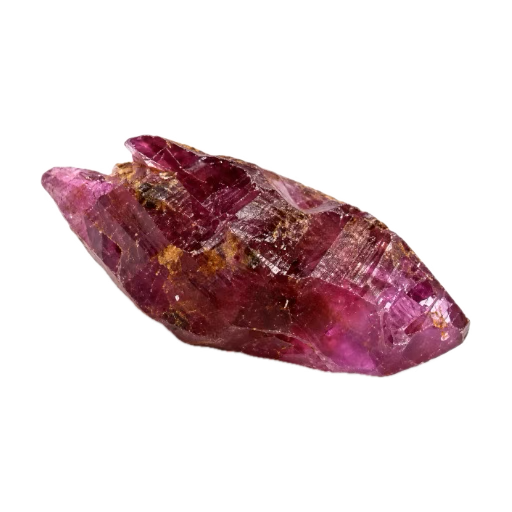
Ruby is the red variety of the mineral corundum, an aluminum oxide. Traces of chromium give it its color.
How to identify ruby
Pink to deep blood-red, with a glassy shine and very high hardness. Cut stones often show fine needle-like inclusions or small cracks. Strong sunlight can make the red seem to glow.
Real or fake ruby: common imitations
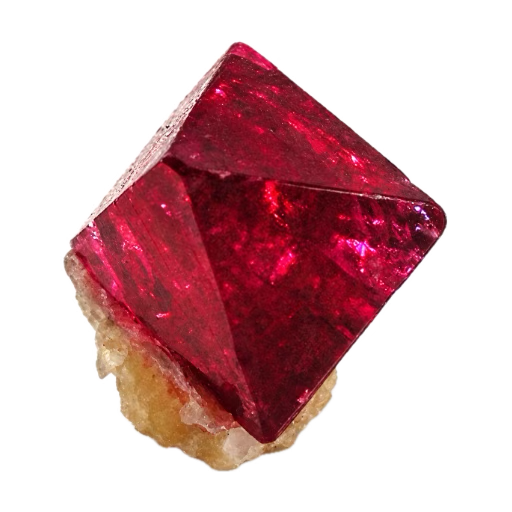
- Red spinel
- Looks very similar and was often sold as ruby. The Black Prince's Ruby of the British crown is a spinel. It usually lacks the needle inclusions of natural ruby.
- Garnet
- Browner or darker red, and softer. Many garnets are cheaper stones sold as ruby.
- Glass-filled ruby
- A cracked low-grade stone with glass filling its fractures. Flashes of color and bubbles show inside the cracks.
- Lab-grown ruby
- Same material as the natural stone. Under a loupe it may show curved growth lines or round bubbles instead of needles.
How much is ruby worth?
At average quality, a walnut-sized rough piece (about 60 g) is worth $61 to $130; a 1 kg rough piece, $580 to $1,200; a 1-carat cut stone, $240 to $860.
| Specimen | Ordinary | Average | Fine |
|---|---|---|---|
| Rough piece, walnut-sizedabout 60 g | $39 to $74 | $61 to $130 | $110 to $230 |
| Rough piece, 1 kg | $370 to $700 | $580 to $1,200 | $1,000 to $2,200 |
| Crystal, egg-sizedabout 199 g | $160 to $480 | $340 to $1,200 | $990 to $3,400 |
| Cut stone, 1 carat0.2 g | $110 to $340 | $240 to $860 | $730 to $2,600 |
Ordinary quality: dull, opaque or chipped. Fine quality: vivid color, clean and translucent stone.
Color decides first: a vivid, saturated red, called “pigeon’s blood”, is worth far more than a pale pink or a brownish red. Next come clarity, weight, cut quality and origin, with Mogok at the top. An unheated ruby, backed by a certificate, sells for noticeably more. A glass-filled ruby is worth little, as are opaque rough rubies sold in their matrix.
These figures are orders of magnitude from Kaillou’s calculator: an estimate, not an appraisal. For a piece that looks exceptional, ask a gemologist. How the calculator works.
Where to find ruby
In marble and other metamorphic rocks, and in the gravel eroded from them. Myanmar's Mogok valley was the classic source, while Mozambique now leads in output.
The most famous “ruby” in the French collections is not one: the Côte-de-Bretagne, kept in the Louvre museum among the Crown Jewels, is a red spinel, carved in the shape of a dragon for Louis XV. France also left its mark on the history of this gem: in 1902, the chemist Auguste Verneuil, a professor at the Muséum national d’histoire naturelle in Paris, announced the synthesis of ruby. Watches have used synthetic rubies ever since.
Good to know
Almost all rubies are heated, and some are filled with glass. Filled stones can be damaged by acids, strong cleaners and torches.
Ruby history and lore
Prized in India and Asia for centuries as one of the most precious gems. In 1960 a synthetic ruby crystal was used to build the first working laser.
Birthstone of July, and one of the traditional cardinal gems.