Kaillou

Hematite
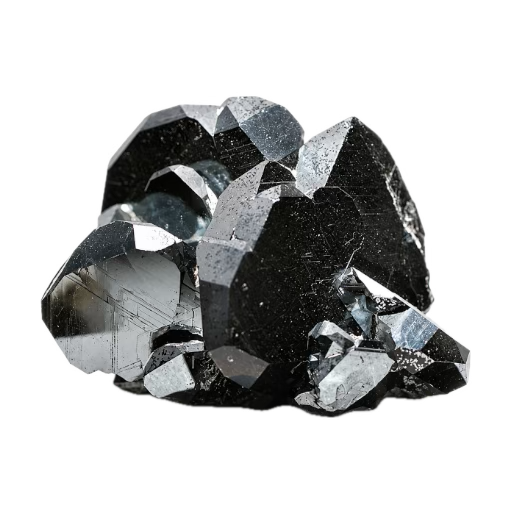
Hematite is an iron oxide and the most important ore of iron. It forms shiny gray crystals and also dull red earthy masses, and always leaves a red-brown streak.
How to identify hematite
Silver-gray to black and metallic in crystals, or dull rusty red in earthy lumps. It is heavy and hard, and rubbing it on unglazed porcelain leaves a red-brown line. A plain magnet barely affects it.
Real or fake hematite: common imitations
- Hematine
- Man-made material sold as magnetic hematite. It sticks strongly to a magnet, which real hematite does not.
- Magnetite
- A black iron oxide that is strongly magnetic and leaves a black streak.
How much is hematite worth?
At average quality, a walnut-sized rough piece (about 79 g) is worth $1 to $4; a 1 kg rough piece, $11 to $24; an egg-sized crystal (about 263 g), $8 to $29.
| Specimen | Ordinary | Average | Fine |
|---|---|---|---|
| Rough piece, walnut-sizedabout 79 g | $1 to $2 | $1 to $4 | $2 to $6 |
| Rough piece, 1 kg | $7 to $14 | $11 to $24 | $21 to $44 |
| Crystal, egg-sizedabout 263 g | $4 to $12 | $8 to $29 | $24 to $82 |
Ordinary quality: dull, opaque or chipped. Fine quality: vivid color, clean and translucent stone.
A piece of hematite picked up off the ground finds no buyer: it is the most abundant iron ore, and the prices in the table are those of specimens sold in shops. What counts is sharp, shiny crystals, well-formed iron roses, clustered masses with a metallic luster, and a famous origin such as the island of Elba. Jewelry sold as “magnetic hematite” is made of hematine, an artificial material.
These figures are orders of magnitude from Kaillou’s calculator: an estimate, not an appraisal. For a piece that looks exceptional, ask a gemologist. How the calculator works.
Where to find hematite
In large banded iron formations, such as the Lake Superior region, Brazil and Western Australia. Fine specimens come from the island of Elba and the Alps.
Several French deposits have produced remarkable specimens. At the locality of Batère, in Corsavy, in the Canigou massif (Pyrénées-Orientales, in the Pyrenees), iron mines were worked from the 2nd century BC until 1987, first in open pits, then in underground tunnels. They yielded “iron roses,” hematite crystals grouped in a rosette. The mines of Rancié, in the Ariège, and Faucogney, in the Haute-Saône, are also among these deposits. In the Chauvet Cave, in the Ardèche, closed to the public, the red of some of the paintings comes from hematite.
Hematite history
Its powder is among the oldest pigments known, used by early humans in southern Africa well over 100,000 years ago. The name comes from the Greek word for blood.