Kaillou

Tiger's eye
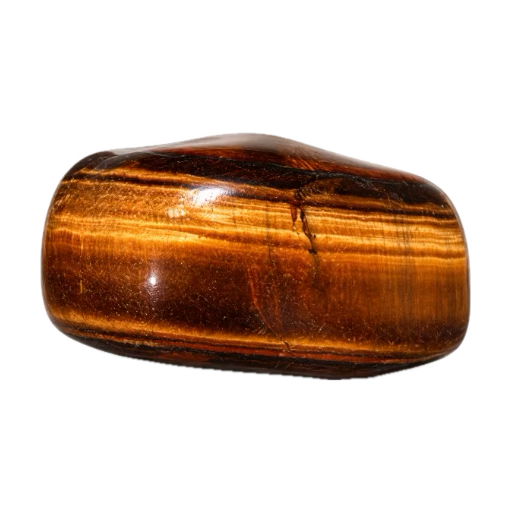
Tiger's eye is a golden-brown quartz stone in which parallel quartz crystals grow together with crocidolite fibers. The fibers, mostly altered to limonite, give it a silky band of light.
How to identify tiger's eye
Golden to reddish brown, opaque, with a moving glow that slides across the surface as the polished stone is turned. The effect is called chatoyancy. It is hard enough to scratch glass.
Real or fake tiger's eye: common imitations
- Fiber-optic glass
- Shows a razor-sharp, perfectly straight line of light, and a honeycomb pattern appears at the ends of the fibers.
- Heat-treated or dyed stone
- Red and honey tones are often made by heating or dye. Color that pools in cracks is a warning sign.
- Serpentine "tiger-eye"
- Stones sold as Arizona or California tiger's eye are softer fibrous serpentine, not quartz.
How much is tiger's eye worth?
At average quality, a walnut-sized rough piece (about 40 g) is worth $1 to $3; a 1 kg rough piece, $14 to $29; an egg-sized crystal (about 132 g), $6 to $21.
| Specimen | Ordinary | Average | Fine |
|---|---|---|---|
| Rough piece, walnut-sizedabout 40 g | $1 to $2 | $1 to $3 | $1 to $4 |
| Rough piece, 1 kg | $9 to $18 | $14 to $29 | $25 to $51 |
| Crystal, egg-sizedabout 132 g | $3 to $9 | $6 to $21 | $18 to $59 |
Ordinary quality: dull, opaque or chipped. Fine quality: vivid color, clean and translucent stone.
The price rests mostly on the chatoyancy: a bright, sharp, mobile band of light, on a deep golden ground with regular bands. Cracks, dull zones and poor polishing lower it. Long rare and expensive, tiger’s eye became affordable when large quantities were found in South Africa. A red color may result from heating, while an overly vivid color may result from dyeing. An ordinary rough piece has little more than souvenir value.
These figures are orders of magnitude from Kaillou’s calculator: an estimate, not an appraisal. For a piece that looks exceptional, ask a gemologist. How the calculator works.
Where to find tiger's eye
Mainly in South Africa and Western Australia, with others in India, Myanmar and Namibia.
Good to know
In the polished stone, the fibers are locked inside the quartz. Sawing, grinding or polishing it, however, releases fine particles: it is best to work it with water. Its fibers come from crocidolite, a form of asbestos.
Tiger's eye history
Cut into domed cabochons, beads and carvings for jewelry and ornaments. Tiger iron, a banded mix with red jasper and hematite, is a related decorative stone.