Kaillou


Jasper
Jasper is an opaque, impure variety of microcrystalline quartz, colored by iron and other minerals mixed into it. It forms in sediment or volcanic ash where silica-rich water has circulated.
How to identify jasper
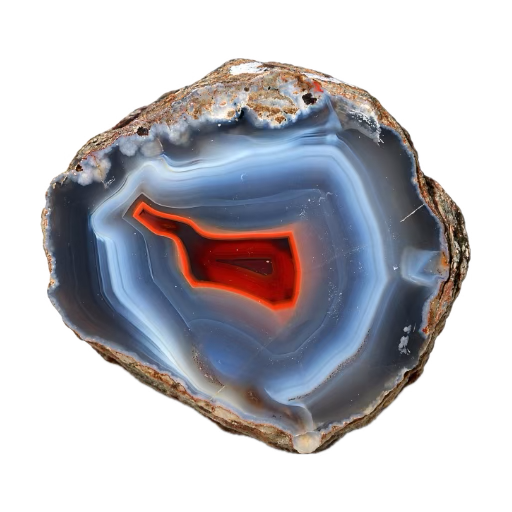
Opaque with an even, waxy to glassy shine once polished, most often brick red, but also yellow, brown or green. Patterns of bands, spots or webs are common. It breaks with smooth, curved surfaces and scratches glass.
Real or fake jasper: common imitations
- Dyed jasper
- Unnaturally bright blue, pink or purple stones are usually dyed. Color often pools in small cracks.
- Glass or plastic
- Feels warmer or lighter than stone, and may show tiny round bubbles.
How much is jasper worth?
At average quality, a walnut-sized rough piece (about 38 g) is worth $1 to $2; a 1 kg rough piece, $12 to $21; an egg-sized crystal (about 125 g), $5 to $15.
| Specimen | Ordinary | Average | Fine |
|---|---|---|---|
| Rough piece, walnut-sizedabout 38 g | $1 to $2 | $1 to $2 | $1 to $3 |
| Rough piece, 1 kg | $8 to $14 | $12 to $21 | $19 to $33 |
| Crystal, egg-sizedabout 125 g | $2 to $7 | $5 to $15 | $12 to $36 |
Ordinary quality: dull, opaque or chipped. Fine quality: vivid color, clean and translucent stone.
Jasper is abundant: the pattern sets the price. A sharp, rare design, well-contrasting bands or spots, a vivid hue and a fine polish count for far more than weight. Dyed jaspers, often an overly bright blue or purple, and glass imitations are worth little. A piece of red jasper picked up in a river rarely resells for more than a few dollars, even polished.
These figures are orders of magnitude from Kaillou’s calculator: an estimate, not an appraisal. For a piece that looks exceptional, ask a gemologist. How the calculator works.
Where to find jasper
In volcanic and sedimentary rocks worldwide. Well-known sources include Indonesia, Madagascar, Oregon and Idaho in the United States.
In France, jasper appears notably at prehistoric sites. At the Caune de l’Arago, in Tautavel (Pyrénées-Orientales, in the Pyrenees), the cave’s occupants could find red jasper at Corneilla-de-Conflent, about forty kilometers away, to make tools. In the Vienne, in western France, the Neanderthal site of Fontmaure yielded many tools, some of them in jasper. The Caune de l’Arago has been classified as a historic monument since 1965.
Jasper history and lore
People made drills from green jasper at Mehrgarh, in present-day Pakistan, more than 6,000 years ago. Minoan craftsmen on Crete carved seals from it around 1800 BC.
Jasper is named among the precious stones in the Book of Revelation, in the description of the New Jerusalem.