Kaillou

Agate
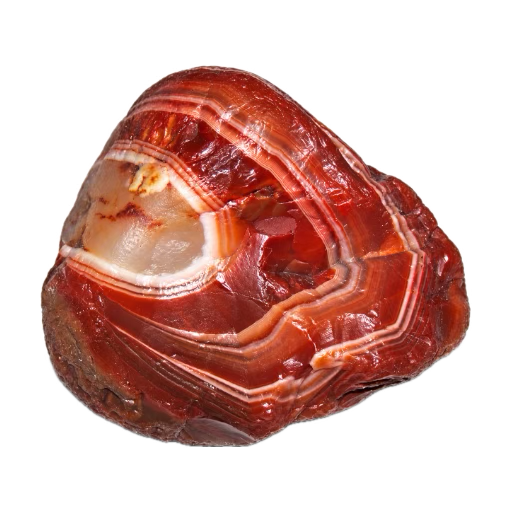
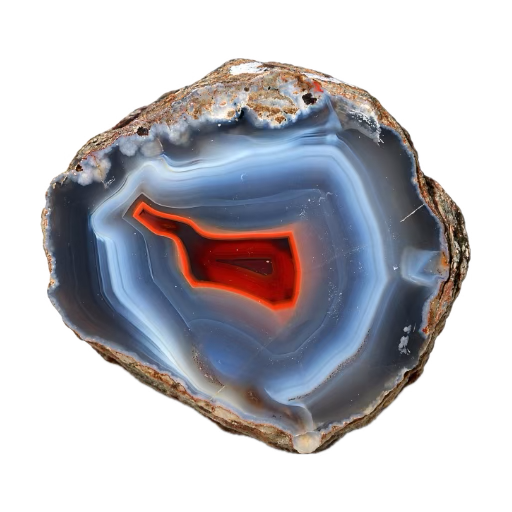
Agate is a banded variety of chalcedony, a fine-grained form of quartz. It usually forms in rounded nodules inside cavities of volcanic rock.
How to identify agate
Curved or straight bands of different colors, a waxy to glassy shine, and light passing through thin edges. Nodules often have a rough, pitted outer skin and a core of quartz crystals.
Real or fake agate: common imitations
- Dyed agate
- Very bright blue, green or purple is almost always dye. The color often pools in cracks.
- Glass
- Shows round bubbles, and its swirls do not follow the shape of the stone as natural bands do.
How much is agate worth?
At average quality, a walnut-sized rough piece (about 39 g) is worth $1 to $3; a 1 kg rough piece, $12 to $28; an egg-sized crystal (about 130 g), $5 to $20.
| Specimen | Ordinary | Average | Fine |
|---|---|---|---|
| Rough piece, walnut-sizedabout 39 g | $1 to $2 | $1 to $3 | $1 to $4 |
| Rough piece, 1 kg | $8 to $16 | $12 to $28 | $24 to $52 |
| Crystal, egg-sizedabout 130 g | $2 to $8 | $5 to $20 | $17 to $60 |
Ordinary quality: dull, opaque or chipped. Fine quality: vivid color, clean and translucent stone.
What sets the price is the pattern: fine, sharp, contrasting bands, vivid natural colors and good translucency. For a nodule or a geode, size, symmetry and the absence of cracks matter too. An agate dyed bright blue, green or purple is worth much less. An ordinary nodule picked up off the ground, with no attractive banding once sawn, has little more than souvenir value.
These figures are orders of magnitude from Kaillou’s calculator: an estimate, not an appraisal. For a piece that looks exceptional, ask a gemologist. How the calculator works.
Where to find agate
In cavities of basalt and other volcanic rock, and loose in gravel once the surrounding rock has eroded. Brazil, Uruguay, Mexico and the shores of Lake Superior are well known.
In the Esterel massif, between the Var and the Alpes-Maritimes in southeastern France, the rhyolites contain lithophysae, old gas bubbles frozen in the lava. In some areas their core is filled with chalcedony or crystallized quartz. A famous piece is kept in Paris: the Ptolemies’ Cup, carved from a single sardonyx, a banded chalcedony, between the 1st century BC and the 1st century AD. For a long time in the treasury of the Abbey of Saint-Denis, it now belongs to the Cabinet des médailles of the Bibliothèque nationale de France.
Agate history
The Greek writer Theophrastus described it around 350 BC and linked its name to a river in Sicily. It has been cut into beads, seals and bowls for thousands of years.