Kaillou

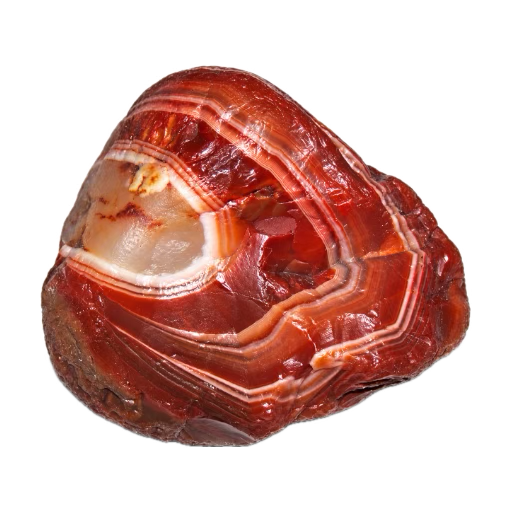
Lake Superior agate
Lake Superior agate is a banded chalcedony, a fine-grained form of quartz, colored by iron. It is thought to be among the oldest agates in the world, around 1.1 billion years old.
How to identify Lake Superior agate
Red, orange and white curved bands in a translucent, waxy stone, often with a rough outer skin dotted with small pits. The bands follow the outline of the stone. Wetting it with water brings out the color.
Real or fake Lake Superior agate: common imitations
- Dyed agate
- Unnaturally bright blue, purple or green bands are usually dyed.
- Carnelian
- Translucent orange-red chalcedony without clear banding.
- Jasper
- Solid color and opaque, without translucent bands.
How much is Lake Superior agate worth?
At average quality, a walnut-sized rough piece (about 39 g) is worth $4 to $12; a 1 kg rough piece, $61 to $160; an egg-sized crystal (about 130 g), $27 to $120.
| Specimen | Ordinary | Average | Fine |
|---|---|---|---|
| Rough piece, walnut-sizedabout 39 g | $2 to $6 | $4 to $12 | $10 to $26 |
| Rough piece, 1 kg | $34 to $78 | $61 to $160 | $130 to $350 |
| Crystal, egg-sizedabout 130 g | $11 to $40 | $27 to $120 | $95 to $400 |
Ordinary quality: dull, opaque or chipped. Fine quality: vivid color, clean and translucent stone.
Only a small share of these agates is judged to be of gem quality. The price follows the sharpness and brightness of the bands, the absence of fractures, a small share of visible quartz, and size: most are no bigger than a marble. “Eyes” or rare colors, such as green or purple, also count. A cracked stone, with blurry bands or dull colors, is used mostly for tumbling or for the garden.
These figures are orders of magnitude from Kaillou’s calculator: an estimate, not an appraisal. For a piece that looks exceptional, ask a gemologist. How the calculator works.
Where to find Lake Superior agate
On the beaches and in the gravel of Lake Superior in Minnesota, Wisconsin, Michigan and Ontario, and in glacial deposits across the Midwest. Some are still in the basalt that formed them.
Lake Superior agate history
They formed inside gas bubbles in lava about 1.1 billion years ago. Ice-age glaciers later broke the basalt apart and spread the agates across the region.