Kaillou

Amethyst
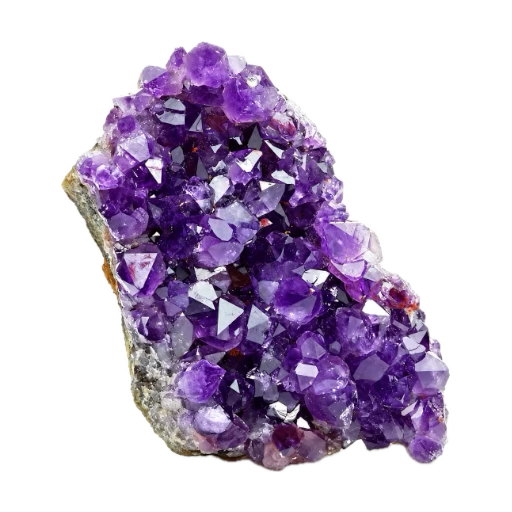
Amethyst is the purple variety of quartz. Traces of iron, changed by natural radiation in the rock, give it its color.
How to identify amethyst
Purple six-sided crystals with pointed tips, often lining a geode. The color is usually deeper at the tips. It is hard enough to scratch glass.
Real or fake amethyst: common imitations
- Glass
- Shows round bubbles and an even color. Natural amethyst has color zones and small inclusions.
- Lab-grown amethyst
- Same material as the natural stone. A loose gem often needs a laboratory test to tell them apart.
How much is amethyst worth?
At average quality, a walnut-sized rough piece (about 40 g) is worth $1 to $3; a 1 kg rough piece, $15 to $27; a 1-carat cut stone, $5 to $10.
| Specimen | Ordinary | Average | Fine |
|---|---|---|---|
| Rough piece, walnut-sizedabout 40 g | $1 to $2 | $1 to $3 | $1 to $4 |
| Rough piece, 1 kg | $11 to $18 | $15 to $27 | $24 to $42 |
| Crystal, egg-sizedabout 133 g | $3 to $10 | $7 to $20 | $17 to $49 |
| Cut stone, 1 carat0.2 g | $3 to $7 | $5 to $10 | $9 to $17 |
Ordinary quality: dull, opaque or chipped. Fine quality: vivid color, clean and translucent stone.
Color accounts for most of the price: a deep, even purple is worth far more than a pale lilac. Next come transparency, the absence of visible inclusions and, for a geode, the size and condition of the crystals. A pale or opaque piece found on the ground is still a nice find, but it rarely resells for more than a few dollars.
These figures are orders of magnitude from Kaillou’s calculator: an estimate, not an appraisal. For a piece that looks exceptional, ask a gemologist. How the calculator works.
Where to find amethyst
In cavities of volcanic rock and in quartz veins. Brazil and Uruguay are famous for their large geodes, and Zambia for its deep colors.
France has deposits of its own. The Livradois, in the Puy-de-Dôme in central France, has several: at Le Vernet-Chaméane, small-scale mining resumed in 2009 on a vein worked until 1974, and at Pégut, in the commune of La Chapelle-sur-Usson, a former mine is open to visitors. The Maison de l’Améthyste, in the château de Montfort, tells this story. Amethysts are also reported in Alsace, at the Hirzenstein rocks in Wattwiller.
Good to know
Long exposure to strong light or heat can fade the color. Heated to around 500 °C (932 °F), amethyst turns yellow: a large share of the citrines sold commercially are made this way.
Amethyst history and lore
Ancient Egyptians used it as a gem, and it long ranked among the most precious stones. Big finds in Brazil later made it affordable.
Birthstone of February. Its name comes from the Greek for "not drunk", and the ancient Greeks carved drinking cups from it.