Kaillou

Tourmaline
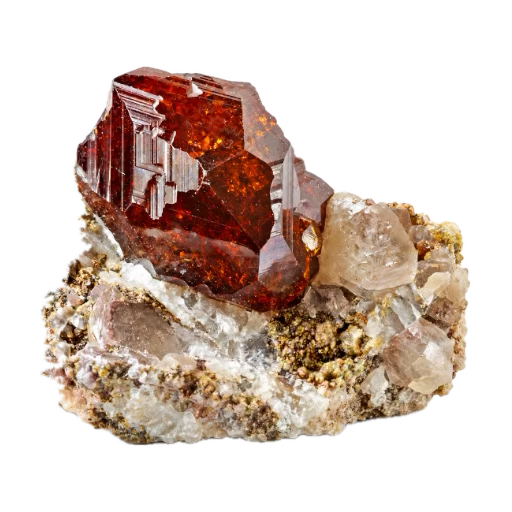
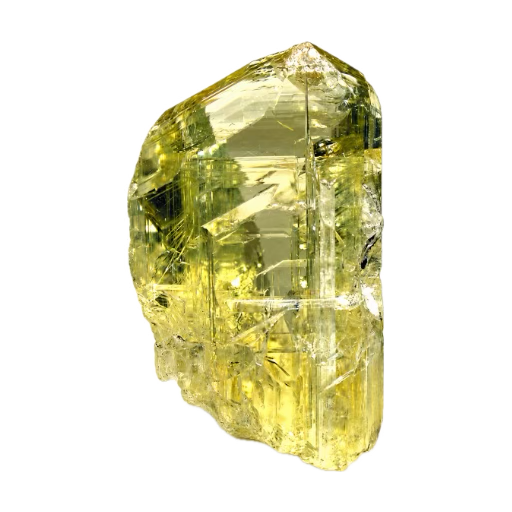
Tourmaline is a group of boron silicate minerals with a very complex chemistry. It occurs in almost every color, and one crystal can show several.
How to identify tourmaline
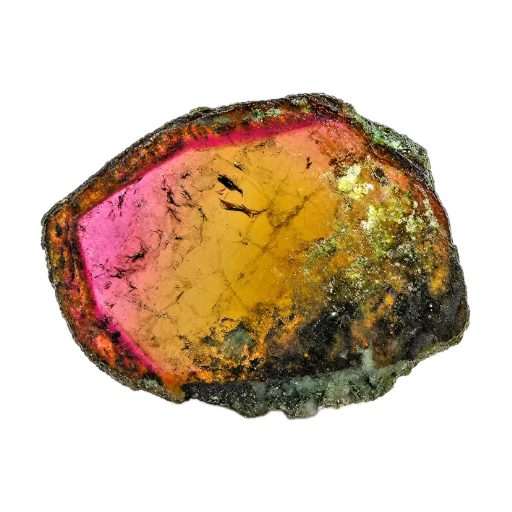
Long prisms with a rounded triangular cross section and deep lengthwise grooves. Black tourmaline (schorl) is the most common, while colored crystals may be pink in the center and green outside. Warming or rubbing can make it attract light dust.
Real or fake tourmaline: common imitations
- Glass
- Shows no change of color when turned and may have round bubbles. It also lacks the grooved, triangular crystal shape.
- Treated stones
- Pink and red stones are often heated or irradiated to improve color. This cannot be seen by eye and needs a laboratory.
How much is tourmaline worth?
At average quality, a walnut-sized rough piece (about 42 g) is worth $2 to $10; a 1 kg rough piece, $33 to $130; a 1-carat cut stone, $43 to $110.
| Specimen | Ordinary | Average | Fine |
|---|---|---|---|
| Rough piece, walnut-sizedabout 42 g | $1 to $4 | $2 to $10 | $8 to $30 |
| Rough piece, 1 kg | $15 to $47 | $33 to $130 | $100 to $380 |
| Crystal, egg-sizedabout 141 g | $5 to $25 | $15 to $96 | $76 to $460 |
| Cut stone, 1 carat0.2 g | $25 to $54 | $43 to $110 | $92 to $230 |
Ordinary quality: dull, opaque or chipped. Fine quality: vivid color, clean and translucent stone.
Color accounts for most of the price. Intensely blue Paraíba tourmalines far outrank all the others; next come pink to red rubellites, vivid greens and bicolor crystals with sharply defined zones. A clear stone of good size is worth much more than one that is too dark or heavily included. A piece of black tourmaline found on the ground rarely resells for more than a few dollars, unless it is a whole, well-terminated crystal.
These figures are orders of magnitude from Kaillou’s calculator: an estimate, not an appraisal. For a piece that looks exceptional, ask a gemologist. How the calculator works.
Where to find tourmaline
Mostly in granite pegmatites, with black schorl in many granites and schists. Brazil, Nigeria, Mozambique, Afghanistan and the island of Elba in Italy are known for colored crystals.
In 1901, the mineralogist H. Arsandaux described, near Brassac, in the Tarn, a pegmatite rich in pink tourmaline, associated with lepidolite. He also found clear bicolor crystals there, pink and green, 5 or 6 cm long, and very large black tourmaline crystals on the way down from the Clap hill. Until then, the only known French deposit of lithium tourmaline was at Orvault, near Nantes, where it is generally green. These observations are more than a century old.
Good to know
Gems with many internal fractures can break during ultrasonic cleaning.
Tourmaline history and lore
Dutch traders brought colored stones from Sri Lanka to Europe in the 18th century, where they were sold as curiosities. In the 19th century, slices of tourmaline were used to polarize light in laboratory instruments.
Birthstone of October. Dutch traders called it the ash puller, because a warmed crystal attracts ash.