Kaillou


Aquamarine
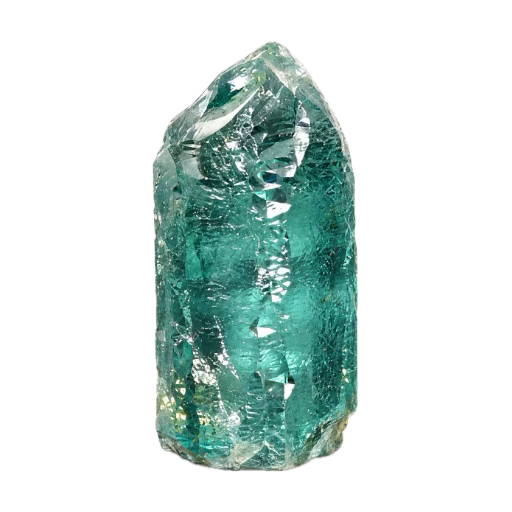
Aquamarine is the pale blue to blue-green variety of the mineral beryl. Iron gives it its color.
How to identify aquamarine
Transparent, glassy, six-sided prisms with fine grooves along their length. The color ranges from light sea blue to greenish blue, and good stones are often very clean. It is hard enough to scratch quartz.
Real or fake aquamarine: common imitations
- Blue topaz
- Similar and common, but often a more intense sky blue and heavier. Most is color-treated.
- Glass or synthetic spinel
- Cheaper blue stones that look alike. Glass shows round bubbles.
- Maxixe
- A deep blue beryl whose color fades in sunlight. Aquamarine does not fade.
How much is aquamarine worth?
At average quality, a walnut-sized rough piece (about 40 g) is worth $5 to $15; a 1 kg rough piece, $72 to $190; a 1-carat cut stone, $60 to $140.
| Specimen | Ordinary | Average | Fine |
|---|---|---|---|
| Rough piece, walnut-sizedabout 40 g | $3 to $7 | $5 to $15 | $12 to $34 |
| Rough piece, 1 kg | $39 to $92 | $72 to $190 | $160 to $440 |
| Crystal, egg-sizedabout 133 g | $13 to $47 | $32 to $150 | $110 to $510 |
| Cut stone, 1 carat0.2 g | $37 to $75 | $60 to $140 | $120 to $270 |
Ordinary quality: dull, opaque or chipped. Fine quality: vivid color, clean and translucent stone.
Color sets the price: a deep, intense blue, sometimes with a faint greenish tint, is the most sought after. Most aquamarines on the market are heated to turn a blue-green into a purer blue. Cut stones are generally very clean, and the price per carat drops for very large stones. An opaque beryl picked up in a pegmatite has no gem value. A certificate describes the stone and its treatments, without guaranteeing a price.
These figures are orders of magnitude from Kaillou’s calculator: an estimate, not an appraisal. For a piece that looks exceptional, ask a gemologist. How the calculator works.
Where to find aquamarine
In granite pegmatites and mineralized veins. Minas Gerais in Brazil is a major source, and others include Pakistan, Madagascar, Mozambique and Nigeria.
In France, aquamarine is reported at a few deposits: at Montredon-Labessonnié, in the Tarn, in the Sainte-Barbe vein of the Montmins mine at Échassières in the Allier, and in the La Lande quarry at Plumelin in the Morbihan. Beryl is more common in the pegmatites of the Limousin, near Ambazac in the Haute-Vienne, but there it is mostly pale green and stony. A quarry remains private ground: the operator’s consent is required to search there.
Aquamarine history and lore
The name comes from Latin words for sea water. The huge Dom Pedro aquamarine, cut from a Brazilian crystal found in the late 1980s, is in the Smithsonian museum in Washington.
Birthstone of March. Sailors once carried it as a lucky charm against shipwreck.