 Kaillou

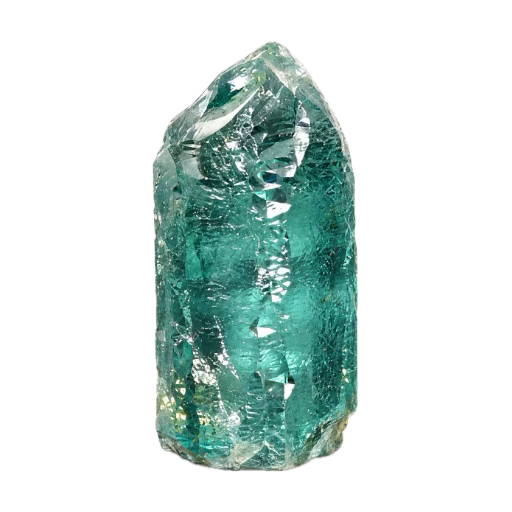
Beryl
Beryl is a beryllium aluminum silicate that grows as six-sided crystals. Pure beryl is colorless, and traces of other elements give the green of emerald, the blue of aquamarine and the pink of morganite.
How to identify beryl
Hexagonal prisms with flat ends, often with fine lengthwise lines and a glassy shine. Common beryl is pale green, yellow or blue, and often cloudy. It is hard enough to scratch quartz.
Real or fake beryl: common imitations
- Glass or doublets
- Glass may show round bubbles and scratches more easily. Doublets show a flat join line when viewed from the side.
- Lab-grown emerald
- Same material as the natural stone but usually cleaner. It usually needs a laboratory test.
- Filled emerald
- Oil or resin hides cracks in many emeralds. Cracks may look cloudy or flash with color.
How much is beryl worth?
At average quality, a walnut-sized rough piece (about 39 g) is worth $2 to $6; a 1 kg rough piece, $27 to $74; a 1-carat cut stone, $18 to $39.
| Specimen | Ordinary | Average | Fine |
|---|---|---|---|
| Rough piece, walnut-sizedabout 39 g | $1 to $3 | $2 to $6 | $4 to $13 |
| Rough piece, 1 kg | $15 to $36 | $27 to $74 | $64 to $180 |
| Crystal, egg-sizedabout 132 g | $4 to $18 | $12 to $55 | $45 to $200 |
| Cut stone, 1 carat0.2 g | $12 to $23 | $18 to $39 | $35 to $73 |
Ordinary quality: dull, opaque or chipped. Fine quality: vivid color, clean and translucent stone.
It all depends on the variety and the transparency. A common beryl, cloudy or pale green, is worth little, unless it is a fine collector crystal. Gem varieties are judged on color and clarity: for aquamarine, the more vivid and intense the blue, the more it is worth, and most of those on the market are heated to obtain a purer blue. Emerald has its own market, but a pale green beryl is not an emerald.
These figures are orders of magnitude from Kaillou’s calculator: an estimate, not an appraisal. For a piece that looks exceptional, ask a gemologist. How the calculator works.
Where to find beryl
Mainly in granite pegmatites, where crystals can grow very large. Brazil is the leading source of aquamarine, while Colombia and Zambia are known for emerald.
Beryl is reported in several regions: at La Villeder, in the Morbihan, near Alençon, in the Orne, at Orvault, in the Loire-Atlantique, near Bagnères-de-Luchon, in the Haute-Garonne, and around Bessines, in the Haute-Vienne, and Autun, in the Saône-et-Loire. In the Chédeville pegmatite, at Ambazac, in the Haute-Vienne, it is described as very rare, in the form of white beryl. The site is protected: collecting minerals there is forbidden, except by special permit for scientific or teaching purposes.
Good to know
It contains beryllium, whose dust is hazardous to breathe, so rough material should be cut wet. Emeralds often have internal cracks and can chip.
Beryl history and lore
The first spectacles in 13th century Italy used lenses cut from beryl or rock crystal, which is why German calls glasses Brille. Beryl is also an ore of the metal beryllium.
Emerald is the birthstone of May, and aquamarine is the birthstone of March.


