Kaillou

Labradorite
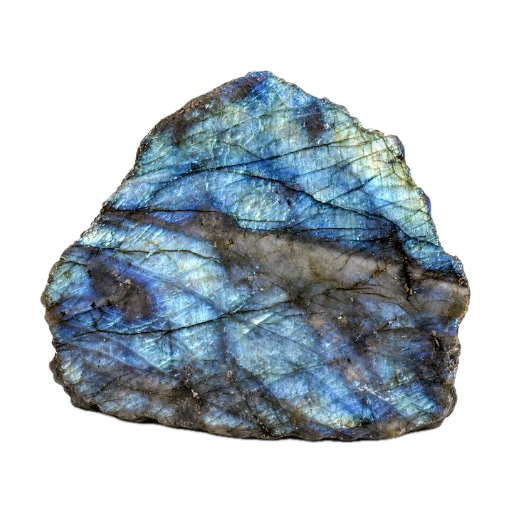
Labradorite is a calcium-sodium feldspar of the plagioclase series. It is known for a metallic flash of color called labradorescence, caused by thin internal layers.
How to identify labradorite
A gray to dark body that flashes blue, green, gold or orange when tilted, but only from certain angles. Fine parallel lines mark the flat cleavage faces. The shine is glassy.
Real or fake labradorite: common imitations
- Moonstone
- Shows a soft, floating blue-white glow rather than a bright flash that switches on and off.
- Glass
- Looks too even, with a flash that does not change with angle.
How much is labradorite worth?
At average quality, a walnut-sized rough piece (about 40 g) is worth $1 to $4; a 1 kg rough piece, $21 to $49; an egg-sized crystal (about 134 g), $9 to $37.
| Specimen | Ordinary | Average | Fine |
|---|---|---|---|
| Rough piece, walnut-sizedabout 40 g | $1 to $2 | $1 to $4 | $3 to $8 |
| Rough piece, 1 kg | $12 to $27 | $21 to $49 | $43 to $110 |
| Crystal, egg-sizedabout 134 g | $4 to $14 | $9 to $37 | $30 to $120 |
Ordinary quality: dull, opaque or chipped. Fine quality: vivid color, clean and translucent stone.
Everything depends on the flash. A vivid, broad flash that stands out against a dark background is worth far more than a faint sheen confined to one corner of the stone. The full range of colors, as in the spectrolite of Finland, is more sought after than blue-green alone. Cutting matters too: a poorly oriented cabochon shows its flash at an angle. A piece without flash remains a modest ornamental stone.
These figures are orders of magnitude from Kaillou’s calculator: an estimate, not an appraisal. For a piece that looks exceptional, ask a gemologist. How the calculator works.
Where to find labradorite
In gabbro, basalt and anorthosite. Labrador in Canada is the namesake locality, with other sources in Finland, Madagascar, Norway and the United States.
Good to know
It has two good cleavage directions, so a hard knock can split it.
Labradorite history and lore
It was named after the Labrador coast of Canada, where it was found on Paul's Island in the 18th century. The Finnish form with strong, varied colors is called spectrolite.
A legend attributed to the Inuit says the northern lights were trapped in the rocks of the Labrador coast, until a warrior freed most of them with a spear.