Kaillou

Travertine
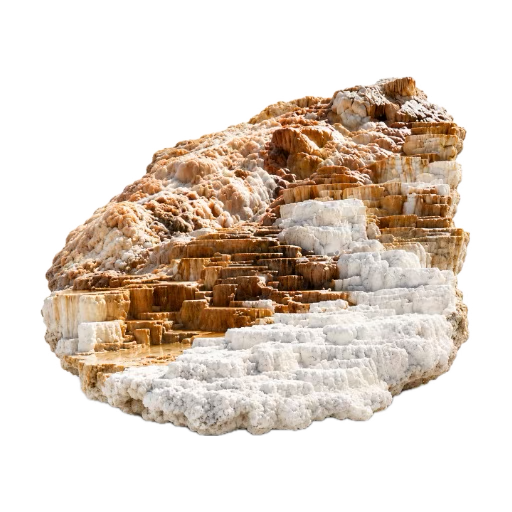
Travertine is a banded limestone that forms when calcium carbonate settles out of spring water, especially around hot springs. It is also found in caves as dripstone.
How to identify travertine
Cream, tan or light brown, with parallel bands and small elongated holes. A steel knife scratches it, and a drop of vinegar makes it fizz. Polished tiles often have the holes filled in.
Real or fake travertine: common imitations
- Tufa
- A similar cold-water deposit that is much lighter, softer and full of large holes.
- Marble
- Dense and crystalline, without the holes and the straight, sedimentary bands.
How much is travertine worth?
At average quality, a walnut-sized rough piece (about 36 g) is worth under $1; a 1 kg rough piece, $7 to $12.
| Specimen | Ordinary | Average | Fine |
|---|---|---|---|
| Rough piece, walnut-sizedabout 36 g | under $1 | under $1 | $1 to $2 |
| Rough piece, 1 kg | $6 to $9 | $7 to $12 | $10 to $16 |
Ordinary quality: dull, opaque or chipped. Fine quality: vivid color, clean and translucent stone.
A piece of travertine picked up has no buyer: the prices in the table are those of samples sold in shops. Travertine is mostly sold as slabs, and their price depends on the evenness of the shade, the number and size of the holes, the finish (saw-cut, aged, honed or polished) and whether the cavities are filled. Only well-preserved fossils, such as leaf imprints, may interest a collector.
These figures are orders of magnitude from Kaillou’s calculator: an estimate, not an appraisal. For a piece that looks exceptional, ask a gemologist. How the calculator works.
Where to find travertine
Around hot springs and in caves, such as Tivoli near Rome, Pamukkale in Turkey and Mammoth Hot Springs in Yellowstone. Italy, Turkey and Iran are major quarrying countries.
The travertine imported into France for paving and coping stones comes mostly from Turkey. The country does have a renowned deposit, however: at Sézanne, in the Marne, the travertine of the Montagne des Grottes, formed in springs and streams in the late Paleocene, has been known since 1842 for its plant imprints. It has also yielded insects, mollusks and small crustaceans. The site is listed in the National Inventory of Geological Heritage.
Good to know
Acids such as lemon juice, vinegar and some cleaners etch the surface and leave dull spots. Its pores can also absorb stains.
Travertine history
Its name comes from Tibur, the Latin name of Tivoli, where the Romans quarried it. The Colosseum in Rome was built largely of travertine.