Kaillou

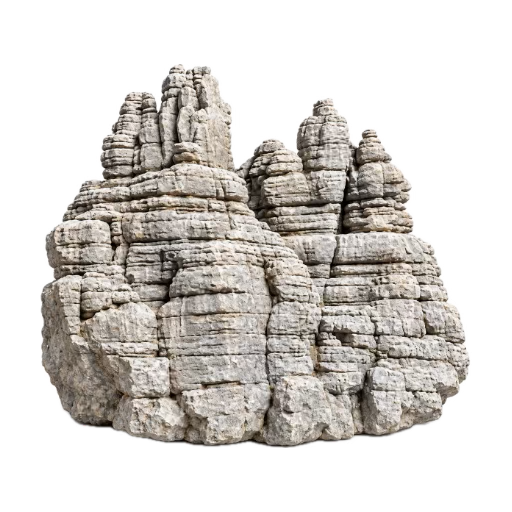
Limestone
Limestone is a sedimentary rock made mostly of calcium carbonate, in the form of calcite and aragonite. Much of it builds up from shells, coral and other remains of sea life.
How to identify limestone
Usually white, gray or cream, fine-grained and dull, often with shell fragments or fossils visible in it. A steel nail scratches it easily, and a drop of vinegar or dilute acid makes it fizz.
Real or fake limestone: common imitations
- Dolomite rock
- Looks the same but fizzes only weakly with acid unless it is powdered.
- Marble
- Limestone changed by heat and pressure. It has sparkling interlocking crystals instead of a dull, earthy surface.
How much is limestone worth?
At average quality, a walnut-sized rough piece (about 35 g) is worth under $1; a 1 kg rough piece, $6 to $10.
| Specimen | Ordinary | Average | Fine |
|---|---|---|---|
| Rough piece, walnut-sizedabout 35 g | under $1 | under $1 | under $1 |
| Rough piece, 1 kg | $5 to $7 | $6 to $10 | $8 to $13 |
Ordinary quality: dull, opaque or chipped. Fine quality: vivid color, clean and translucent stone.
A piece of limestone picked up outdoors finds no buyer: the few dollars in the table match the price of a labeled sample sold in a shop. Fossils change the picture: a well-prepared ammonite, a complete sea urchin or a slab rich in shells can interest a collector, depending on condition and origin. The price of dimension stone mainly reflects the cost of quarrying and cutting it.
These figures are orders of magnitude from Kaillou’s calculator: an estimate, not an appraisal. For a piece that looks exceptional, ask a gemologist. How the calculator works.
Where to find limestone
In layered rock on every continent, especially where shallow seas once lay. It forms cliffs, caves and karst landscapes.
It is the most common rock in France: it is found in the Alps, the Jura and the Pyrenees, in Champagne, in the Paris Basin and on plateaus such as the Larzac. Most of the cut-stone monuments and buildings in Paris are made of Lutetian limestone, long quarried under the city. Nearly three hundred kilometers of tunnels remain, part of which became the catacombs. Outside the route open to the public, access to the quarries has been forbidden since 1955.
Good to know
Weak acids such as vinegar, lemon juice or acid rain slowly dissolve it, and acidic cleaners etch polished pieces.
Limestone history
Limestone has been quarried as building stone since antiquity, including for the core of the Egyptian pyramids. Burned to make lime, it is also a key ingredient of cement and mortar.