Kaillou

Sandstone
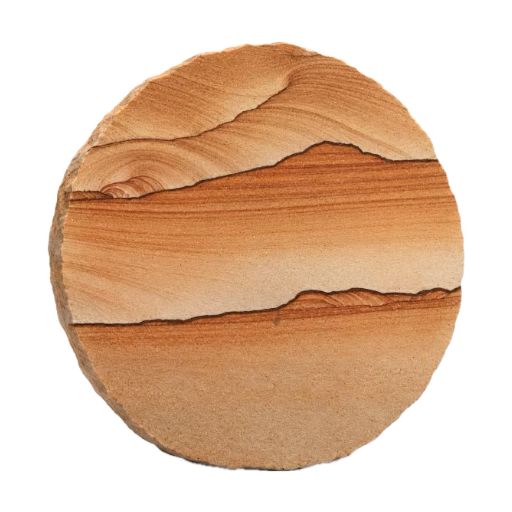
Sandstone is a sedimentary rock made of sand grains pressed and cemented together. Quartz is the most common grain, and the cement sets the rock's color and strength.
How to identify sandstone
A gritty surface of rounded grains that are easy to see or feel, usually in tan, red, brown or gray. Rubbing may loosen a few grains, and layers are often visible on cut or weathered faces.
Real or fake sandstone: common imitations
- Quartzite
- Sandstone heated and squeezed until the grains fuse. It is much harder and breaks through the grains rather than around them.
How much is sandstone worth?
At average quality, a walnut-sized rough piece (about 33 g) is worth under $1; a 1 kg rough piece, $6 to $11.
| Specimen | Ordinary | Average | Fine |
|---|---|---|---|
| Rough piece, walnut-sizedabout 33 g | under $1 | under $1 | $1 to $2 |
| Rough piece, 1 kg | $5 to $8 | $6 to $11 | $10 to $16 |
Ordinary quality: dull, opaque or chipped. Fine quality: vivid color, clean and translucent stone.
A piece of sandstone picked up has no buyer: the prices in the table are those of samples sold in shops. Its ordinary value is that of a building, paving or cobblestone material. A few pieces stand out, though: concretions with striking shapes, such as the gogottes of Fontainebleau, with which Louis XIV decorated fountains at Versailles, appeal to collectors, as does a sandstone holding a well-preserved fossil.
These figures are orders of magnitude from Kaillou’s calculator: an estimate, not an appraisal. For a piece that looks exceptional, ask a gemologist. How the calculator works.
Where to find sandstone
In layered cliffs, canyons and deserts on every continent. The red rock country of the American Southwest is a famous example.
In France, sandstone has mainly been used to pave city streets. In the forest of Fontainebleau, in Seine-et-Marne near Paris, it was quarried from 1330 and used from the 16th century to pave the streets of Paris. The last quarry of the estate closed in 1907, and the last of the massif, at Trois-Pignons, in 1983. Strasbourg Cathedral is built mostly of pink sandstone, partly taken from the quarries of Wasselonne and Dinsheim-sur-Bruche, in the Bas-Rhin in eastern France.
Sandstone history
Used as building stone since antiquity, including the temples of Angkor and the carved city of Petra. It remains common for walls, paving and monuments.