Kaillou

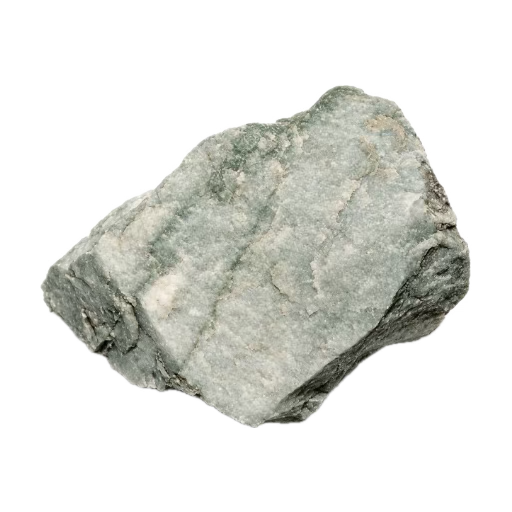
Quartzite
Quartzite is a very hard metamorphic rock formed when quartz sandstone is heated and squeezed deep in the crust. The sand grains fuse into a dense mass of interlocking quartz.
How to identify quartzite
White, gray, pink or reddish, with a sugary, sparkly look on fresh breaks. Unlike sandstone, it breaks through the grains instead of around them. It scratches glass and steel cannot scratch it.
Real or fake quartzite: common imitations
- Sandstone
- Softer and grainy. Sand rubs off under the fingers and it breaks around the grains.
- Engineered quartz
- A man-made slab of crushed quartz and resin. The pattern repeats and the surface is uniform.
How much is quartzite worth?
At average quality, a walnut-sized rough piece (about 39 g) is worth under $1; a 1 kg rough piece, $7 to $10.
| Specimen | Ordinary | Average | Fine |
|---|---|---|---|
| Rough piece, walnut-sizedabout 39 g | under $1 | under $1 | under $1 |
| Rough piece, 1 kg | $6 to $9 | $7 to $10 | $9 to $13 |
Ordinary quality: dull, opaque or chipped. Fine quality: vivid color, clean and translucent stone.
A piece of quartzite picked up from the ground finds no buyer: the prices in the table are those of specimens sold in shops. It is sold mostly crushed, for roads and railway ballast, or as polished slabs, where color, uniformity and the absence of cracks matter. A prehistoric tool made of quartzite interests mainly archaeologists, provided it is known where it was found: in France, such a find must be reported to the mayor of the commune.
These figures are orders of magnitude from Kaillou’s calculator: an estimate, not an appraisal. For a piece that looks exceptional, ask a gemologist. How the calculator works.
Where to find quartzite
As bare ridges and hilltops in old mountain belts, because it resists weathering. The Appalachians in the United States are one example.
In France, in the Vendée, quartzite forms the backbone of the hills of the Rochers de Mouilleron, Cheffois and La Châtaigneraie. At Cheffois, a quarry supplied materials from 1896 to 1953 for roads and railways in western and southwestern France, initially through small-scale operations and then on an industrial scale from 1920. Flooded, it now forms a lake lined with trails. In Paris, at Les Invalides, Napoleon’s sarcophagus is cut from a red quartzite from Karelia, not from porphyry.
Good to know
Cutting and grinding release fine silica dust, which harms the lungs. Wet cutting and a mask reduce the risk.
Quartzite history
Prehistoric people shaped it into stone tools where better flint was scarce. Today it is crushed for road and railway stone and cut for countertops and paving.