Kaillou


Gneiss
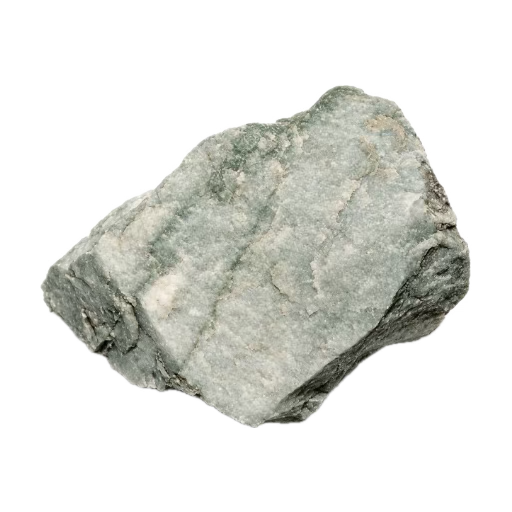
Gneiss is a coarse metamorphic rock formed at high temperature and pressure from igneous or sedimentary rocks. It is known for its bands of alternating light and dark minerals.
How to identify gneiss
Visible grains arranged in straight or wavy bands, with pale layers of quartz and feldspar alternating with dark layers of mica or hornblende. Unlike schist, it does not split easily into thin flakes.
How much is gneiss worth?
At average quality, a walnut-sized rough piece (about 39 g) is worth under $1; a 1 kg rough piece, $6 to $11.
| Specimen | Ordinary | Average | Fine |
|---|---|---|---|
| Rough piece, walnut-sizedabout 39 g | under $1 | under $1 | $1 to $2 |
| Rough piece, 1 kg | $5 to $8 | $6 to $11 | $9 to $15 |
Ordinary quality: dull, opaque or chipped. Fine quality: vivid color, clean and translucent stone.
A block of gneiss picked up has no buyer: the prices in the table are those of samples sold in shops. Gneiss is mostly sold as building, paving or countertop stone, where strength, the regularity of the bands and the beauty of the pattern count. A collector is only interested in well-formed crystals caught in the rock, such as garnets, or in a sample from a famous outcrop.
These figures are orders of magnitude from Kaillou’s calculator: an estimate, not an appraisal. For a piece that looks exceptional, ask a gemologist. How the calculator works.
Where to find gneiss
In the old, deeply eroded cores of continents and in the roots of mountain ranges, such as Canada, Greenland, Scandinavia and northwest Scotland.
The Icartian gneisses, about 2 billion years old, are among the oldest rocks in mainland France. Only rare outcrops remain: at Jobourg, on the Cap de la Hague in the Manche, at Port-Béni in the commune of Pleubian and at Trébeurden in the Côtes-d’Armor, or at Locquirec in the Finistère, all in Normandy and Brittany in western France. At Port-Béni, a broad rock platform visible at low tide shows augen and banded gneisses. The site is protected, and part of it belongs to private owners.
Gneiss history
Some of the oldest known rocks on Earth are gneisses, including the Acasta Gneiss in northern Canada. It is cut for building stone, paving and countertops.