Kaillou

Bismuth
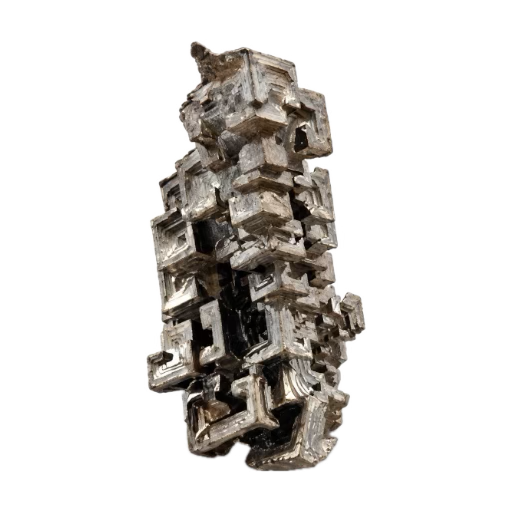
Bismuth is a brittle, heavy metal with a silvery color and a faint pink tint. Natural bismuth is uncommon, and most of the metal is recovered from ores of other metals.
How to identify bismuth
Silvery metal with a pinkish cast that breaks instead of bending. The colorful stair-stepped spiral crystals seen in shops have a thin rainbow film of yellow, pink and blue. Natural pieces are usually dull gray grains or masses.
Real or fake bismuth: common imitations
- Lab-grown crystals
- Nearly all the rainbow spiral crystals on sale are made by melting and slowly cooling the metal. Natural bismuth rarely forms them.
- Lead
- Duller bluish gray and soft enough to bend and mark paper. Bismuth is brittle and snaps.
How much is bismuth worth?
At average quality, a walnut-sized rough piece (about 146 g) is worth $14 to $29; a 1 kg rough piece, $67 to $140.
| Specimen | Ordinary | Average | Fine |
|---|---|---|---|
| Rough piece, walnut-sizedabout 146 g | $9 to $18 | $14 to $29 | $25 to $51 |
| Rough piece, 1 kg | $44 to $80 | $67 to $140 | $120 to $240 |
Ordinary quality: dull, opaque or chipped. Fine quality: vivid color, clean and translucent stone.
Nearly all the stepped, iridescent crystals on the market are made by melting the metal: they remain cheap, and their price depends mostly on size, shape and the brightness of the colors. Such a crystal sold as natural should raise suspicion. Native bismuth, which is rare, interests collectors when it forms sharp crystals, as in Bolivia. A dull gray mass picked up off the ground hardly finds a buyer.
These figures are orders of magnitude from Kaillou’s calculator: an estimate, not an appraisal. For a piece that looks exceptional, ask a gemologist. How the calculator works.
Where to find bismuth
In small amounts in veins with tin, tungsten and silver ores and in granite pegmatites. Saxony in Germany and Bolivia are classic localities, and China is the largest producer today.
In France, bismuth is mostly associated with Meymac, in the Corrèze. A bismuth-rich quartz vein was mined there from 1867 for its ores, accompanied by native bismuth in large blades. The chemist Adolphe Carnot analyzed a sample of this native bismuth in 1874: it was about 99% pure. A mineral is in fact named after the commune, meymacite. In the Haute-Vienne, the Puy-les-Vignes tungsten mine, near Saint-Léonard-de-Noblat, has also yielded native bismuth.
Good to know
The metal is less toxic than lead, but its fumes and salts are toxic. When growing crystals yourself, it is better to melt the bismuth in a well-ventilated place.
Bismuth history
Known since ancient times but long confused with tin and lead, until chemists proved in the 1700s that it was a separate metal. It was used in printing type alloys, and it now replaces lead in many alloys.