Kaillou


Concretion
A concretion is a hard lump formed when minerals cement the grains of a sedimentary layer around a center. It is usually harder than the rock around it, so it often weathers out.
How to identify a concretion
Round, oval or oddly shaped lumps in gray, brown, tan or reddish tones, usually with a plain dull surface. Cut open, they may show concentric layers or a shell or fossil at the center.
Real or fake concretion: common imitations
- Dinosaur egg
- Concretions are often mistaken for eggs. They are solid and have no shell texture.
- Geode
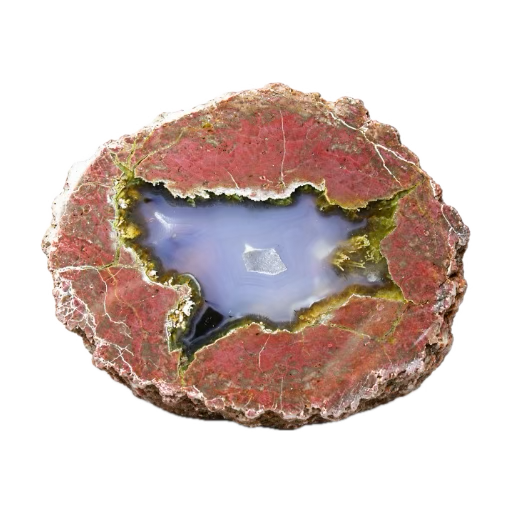
- Looks alike outside but is hollow and lined with crystals, while a concretion is solid.
How much is a concretion worth?
At average quality, a walnut-sized rough piece (about 40 g) is worth $1 to $2; a 1 kg rough piece, $6 to $14.
| Specimen | Ordinary | Average | Fine |
|---|---|---|---|
| Rough piece, walnut-sizedabout 40 g | under $1 | $1 to $2 | $1 to $2 |
| Rough piece, 1 kg | $4 to $9 | $6 to $14 | $12 to $25 |
Ordinary quality: dull, opaque or chipped. Fine quality: vivid color, clean and translucent stone.
An ordinary concretion picked up from the ground finds no buyer: the prices in the table are those of samples sold in shops. What counts is the shape (the stranger or more harmonious it is, the better it sells), the condition of the surface and what it contains: a well-preserved fossil at the heart of an opened concretion can interest a collector. The gogottes of Fontainebleau, sought after for their sculpture-like shapes, form a market of their own and sometimes reach high prices at auction.
These figures are orders of magnitude from Kaillou’s calculator: an estimate, not an appraisal. For a piece that looks exceptional, ask a gemologist. How the calculator works.
Where to find a concretion
Eroding out of shale, clay and sandstone in cliffs, stream banks and beaches. The Moeraki Boulders in New Zealand are famous giant examples.
The most famous French concretions are the gogottes, sandstones of strange shapes formed in the very pure siliceous sands of the Fontainebleau forest. Louis XIV had a few fountains in the park of the Château de Versailles decorated with them. These stones have a place in natural history museums: the one in Bourges keeps one. In Alsace, at Geispolsheim, the loess also contains small limestone concretions, called poupées du lœss (“loess dolls”).
Concretion history
Concretions have long been treated as curiosities. Over time people have taken them for eggs, fossils and even human-made objects.