 Kaillou

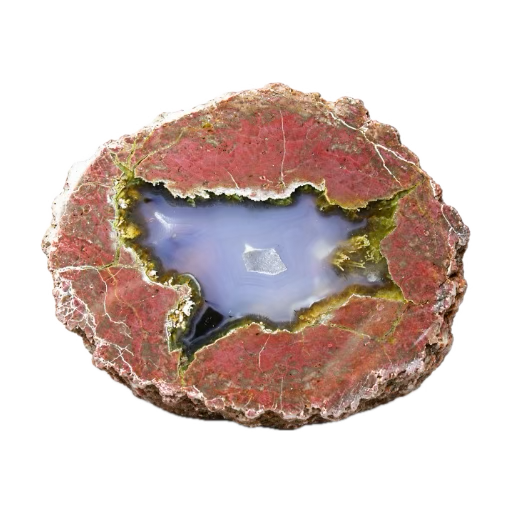
Thunderegg
A thunderegg is a rounded, nodule-like rock that forms inside layers of rhyolite volcanic ash. Its center is often filled with agate, jasper or opal.
How to identify a thunderegg
A rough, lumpy ball with a plain brown or gray shell, from about the size of a baseball and sometimes much larger. It looks like an ordinary rock outside. Cut and polished, it can show bands, patterns and bright colors inside.
Real or fake thunderegg: common imitations
- Geode
- Hollow inside and lined with crystals, while a thunderegg is usually solid.
- Dyed slice
- Cut pieces with very bright or uniform colors may be dyed. Natural patterns are less regular.
How much is a thunderegg worth?
At average quality, a walnut-sized rough piece (about 40 g) is worth $1 to $3; a 1 kg rough piece, $13 to $29.
| Specimen | Ordinary | Average | Fine |
|---|---|---|---|
| Rough piece, walnut-sizedabout 40 g | $1 to $2 | $1 to $3 | $1 to $5 |
| Rough piece, 1 kg | $8 to $17 | $13 to $29 | $26 to $54 |
Ordinary quality: dull, opaque or chipped. Fine quality: vivid color, clean and translucent stone.
Everything depends on the inside, invisible until the stone is sawn. An agate core with vivid colors and sharp patterns, or one filled with opal, is worth far more than a dull or cracked filling. Sawn and polished pairs sell better than whole eggs, whose purchase is something of a gamble. The original locality counts too. The main appeal of an ordinary thunderegg found on the ground is the surprise of what cutting it open reveals. Slices with colors that are too bright may be dyed.
These figures are orders of magnitude from Kaillou’s calculator: an estimate, not an appraisal. For a piece that looks exceptional, ask a gemologist. How the calculator works.
Where to find a thunderegg
In rhyolite lava and ash layers. Oregon is the most famous source, with others in Germany, Ethiopia, Mexico and Australia.
In France, thundereggs are reported in the Estérel massif, between the Var and the Alpes-Maritimes (southeastern France). Its rhyolite holds, in places, lithophysae: onion-skin balls born from gas bubbles in the lava. In some areas their core is filled with chalcedony or quartz. At Théoule-sur-Mer, in the Alpes-Maritimes, a block on the Magellan beach holds thousands of them, but there they are hollow.
Thunderegg history and lore
Oregon made the thunderegg its state rock in 1965, after a campaign by a local rock club. The largest known, weighing 1.75 tons, is in a museum in Hillsboro, Oregon.
A Native American legend reported in Oregon describes them as eggs hurled between thunder spirits on Mount Hood and Mount Jefferson.


