Kaillou


Geode
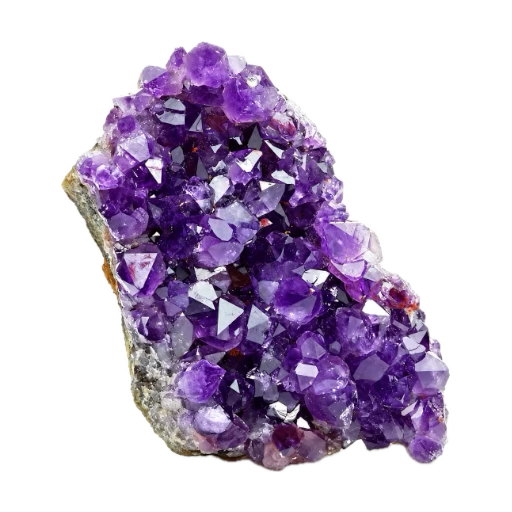
A geode is a roughly round rock with a hollow inside, lined with crystals. It forms when mineral-rich water slowly coats the inside of a cavity in volcanic or sedimentary rock.
How to identify a geode
A plain lumpy ball or potato shape, gray to brown, often with a bumpy outer shell. It may feel lighter than a solid rock of the same size. Cut open, it shows a crust of crystals around a hollow center.
Real or fake geode: common imitations
- Thunderegg
- Looks alike outside, but is usually filled with agate or jasper instead of being hollow.
- Dyed geode
- Electric blue, pink or green crystals are painted or dyed. Natural color is softer and uneven.
How much is a geode worth?
At average quality, a walnut-sized rough piece (about 40 g) is worth $1 to $2; a 1 kg rough piece, $12 to $26.
| Specimen | Ordinary | Average | Fine |
|---|---|---|---|
| Rough piece, walnut-sizedabout 40 g | $1 to $2 | $1 to $2 | $1 to $4 |
| Rough piece, 1 kg | $7 to $15 | $12 to $26 | $23 to $51 |
Ordinary quality: dull, opaque or chipped. Fine quality: vivid color, clean and translucent stone.
A geode’s price depends primarily on its crystals: their color, clarity, size and condition. A vivid violet amethyst is worth more than a white quartz, and an intact geode more than a glued one, a repair that must be disclosed to the buyer. Colors that are too bright can betray a dye, a common practice. A small geode picked up, lined with ordinary quartz, remains a lovely find, but it rarely resells for more than a few dollars.
These figures are orders of magnitude from Kaillou’s calculator: an estimate, not an appraisal. For a piece that looks exceptional, ask a gemologist. How the calculator works.
Where to find a geode
In basalt and in some limestones and shales. Many commercial geodes come from Brazil, Uruguay, Namibia and Mexico, and Iowa, Indiana, Missouri and Kentucky are known in the United States.
In the Alps, crystal hunters call cavities lined with quartz “crystal ovens”: the most sought after are in the Mont Blanc and Oisans massifs. Above Le Bourg-d’Oisans, in Isère, in the commune of Villard-Notre-Dame, the vein of the former La Gardette mine contained enormous geodes with walls covered in very clear crystals. Interest in these cavities is old: at Sandouville, in the Seine-Maritime, a quartz geode cut in the Neolithic has been found.
Geode history
The name comes from a Greek word meaning earthlike. One of the largest known is the Pulpi Geode in Spain, found in 1999 in an old silver mine and lined with giant gypsum crystals.