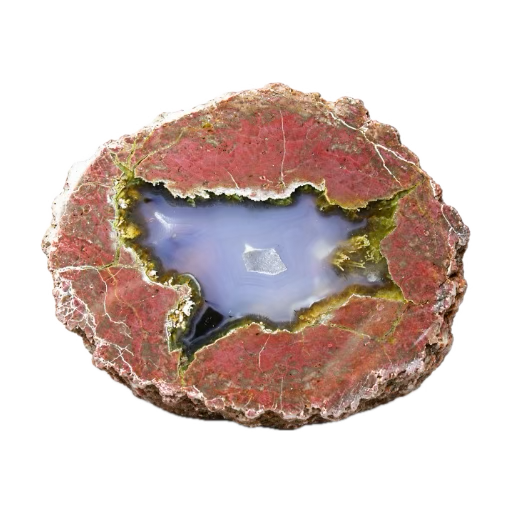
Kaillou


Hag stone
A hag stone is any stone with a natural hole through it, most often flint shaped by water. It is defined by its form rather than by its mineral.
How to identify a hag stone
A pebble, often gray, brown or white, with a hole running clear through. The hole has smooth, irregular edges and often a funnel shape. It is common on pebble beaches.
Real or fake hag stone: common imitations
- Drilled stone
- A hole made by a tool is round and straight-sided, often with fine rings or scratches inside.
How much is a hag stone worth?
At average quality, a walnut-sized rough piece (about 40 g) is worth $1 to $2; a 1 kg rough piece, $8 to $17.
| Specimen | Ordinary | Average | Fine |
|---|---|---|---|
| Rough piece, walnut-sizedabout 40 g | under $1 | $1 to $2 | $1 to $3 |
| Rough piece, 1 kg | $5 to $11 | $8 to $17 | $15 to $31 |
Ordinary quality: dull, opaque or chipped. Fine quality: vivid color, clean and translucent stone.
A hag stone is not sold for its material: it is almost always an ordinary flint, which has no buyer. Everything depends on the shape: a clean hole going all the way through, a smooth and regular stone, sometimes several holes. Its value remains mostly sentimental or decorative. A very round hole with straight walls, scored on the inside, betrays drilling with a tool: the stone then loses what made it unique.
These figures are orders of magnitude from Kaillou’s calculator: an estimate, not an appraisal. For a piece that looks exceptional, ask a gemologist. How the calculator works.
Where to find a hag stone
On beaches and in riverbeds, especially along the North Sea and Baltic coasts of northern Germany and on the coasts of Britain.
Good to know
In France, collecting stones on a beach can result in a fine of up to €1,500. The Environmental Code allows collection to be limited or banned where it threatens the integrity of beaches, dunes and cliffs.
Hag stone history and lore
Archaeologists have found flint stones with natural holes in both Britain and Egypt. The Roman writer Pliny recorded that the Druids prized a similar object called the serpent's egg.
In folk tradition across Britain and Germany, a stone with a hole was hung on a door, bed or stable as protection from witches and bad luck. It has many local names, such as witch stone, adderstone and Hühnergott.