Kaillou

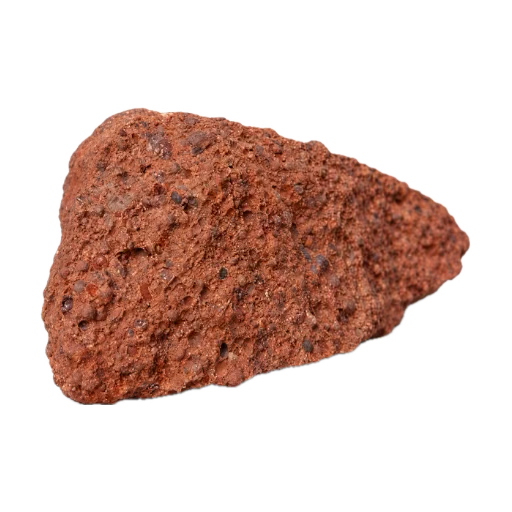
Bauxite
Bauxite is a sedimentary rock and the main ore of aluminum. It is a mix of aluminum minerals and iron oxides, formed by intense weathering in warm, wet climates.
How to identify bauxite
Dull, earthy rock in reddish-brown, yellow, tan, pink or white. It often contains small rounded pea-like grains in a clay-like mass. It is soft, crumbly, and lighter than iron ore.
Real or fake bauxite: common imitations
- Laterite
- Related red-brown weathering crust, but richer in iron. It is usually darker and rustier.
- Iron ore
- Hematite and goethite ores are noticeably heavier and leave red or brown streaks.
How much is bauxite worth?
At average quality, a walnut-sized rough piece (about 30 g) is worth under $1; a 1 kg rough piece, $6 to $11.
| Specimen | Ordinary | Average | Fine |
|---|---|---|---|
| Rough piece, walnut-sizedabout 30 g | under $1 | under $1 | under $1 |
| Rough piece, 1 kg | $5 to $8 | $6 to $11 | $9 to $15 |
Ordinary quality: dull, opaque or chipped. Fine quality: vivid color, clean and translucent stone.
Bauxite is an ore: it is sold by the metric ton to alumina plants, and its price depends mainly on its aluminum content. A piece picked up off the ground therefore finds no buyer. Only a few collector samples, with small round grains clearly visible or from a historic site such as Les Baux-de-Provence, may interest an enthusiast. Their interest lies in history and geology more than in the material.
These figures are orders of magnitude from Kaillou’s calculator: an estimate, not an appraisal. For a piece that looks exceptional, ask a gemologist. How the calculator works.
Where to find bauxite
Mainly in tropical regions, in layers close to the surface. Guinea is the largest producer, followed by Australia and China, with others in Jamaica and Brazil.
Bauxite owes its name to Les Baux-de-Provence, in the Bouches-du-Rhône, where Pierre Berthier discovered it in 1821. France remained the world’s leading producer until the Second World War, except just after the First. The Var was its main deposit, with mines at Mazaugues, Brignoles, Vins, Le Val, Cabasse and Le Luc. Mining there stopped around 1990. In Tourves, the Musée des Gueules Rouges tells this story and offers a guided tour of a reconstructed mine tunnel.
Bauxite history
The French geologist Pierre Berthier described it in 1821 near Les Baux in southern France, which gave it its name. It became the world's aluminum ore once a cheap electrical process was developed in the 1880s.