Kaillou

How to Tell if a Rock Is a Meteorite
A black rock, heavy and a little odd, found in a field: could it have come from space? It’s a fair question, but the answer is almost always no: the meteorite expert at Washington University in St. Louis receives photos of dozens of look-alikes every week. As of early 2024, fewer than 2,000 meteorites had been found and verified in the whole United States in more than two centuries, and only about 160 of them were seen to fall. Here are the clues that help you sort them out, and what to do if your rock checks every box.
A thin, smooth, dark crust
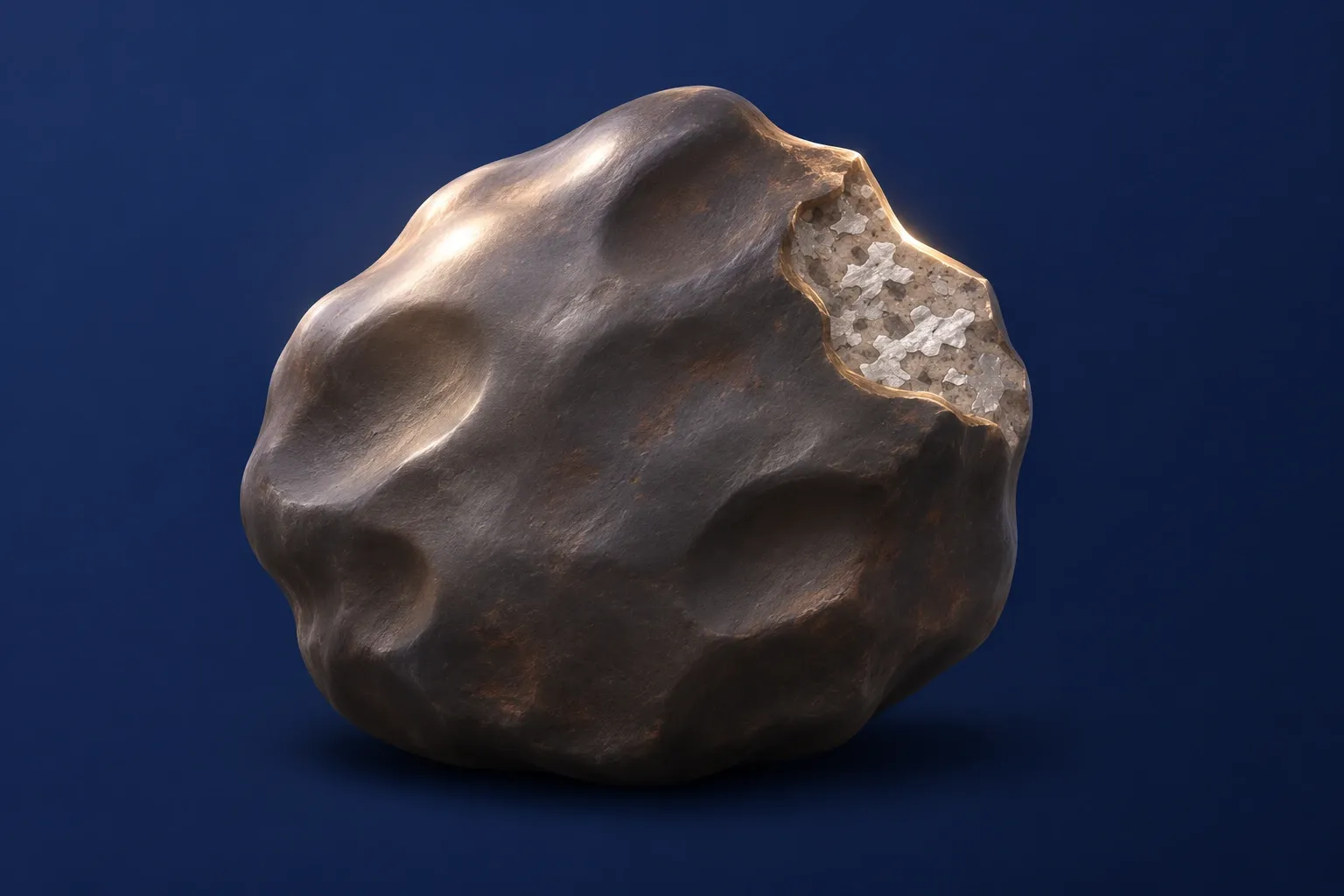
As a meteorite passes through the atmosphere, its surface melts, then hardens into a thin fusion crust, less than a millimeter (0.04 in) thick and sometimes cracked. On a fresh fall it is often black. Over time it can turn brown as it oxidizes, or wear away on one side.
A meteorite’s surface tends to be even, without jagged bumps. Some carry rounded hollows, like thumbprints pressed into modeling clay: specialists call them regmaglypts. The edges are rounded off.
Heavy, and often full of metal
Most meteorites contain metallic iron and nickel, which often makes them heavy for their size, denser than most Earth rocks such as basalt. Iron meteorites, made almost entirely of this alloy, have a specific gravity of 7 to 8. A few rare meteorites are light, though: weight alone isn’t enough.
If the rock is already broken, look inside. You will often see small grains of shiny metal. Chondrites make up about 86% of the meteorites found on Earth, and most of them contain chondrules: small beads of rock, often about a millimeter across, which are almost absent from Earth rocks.
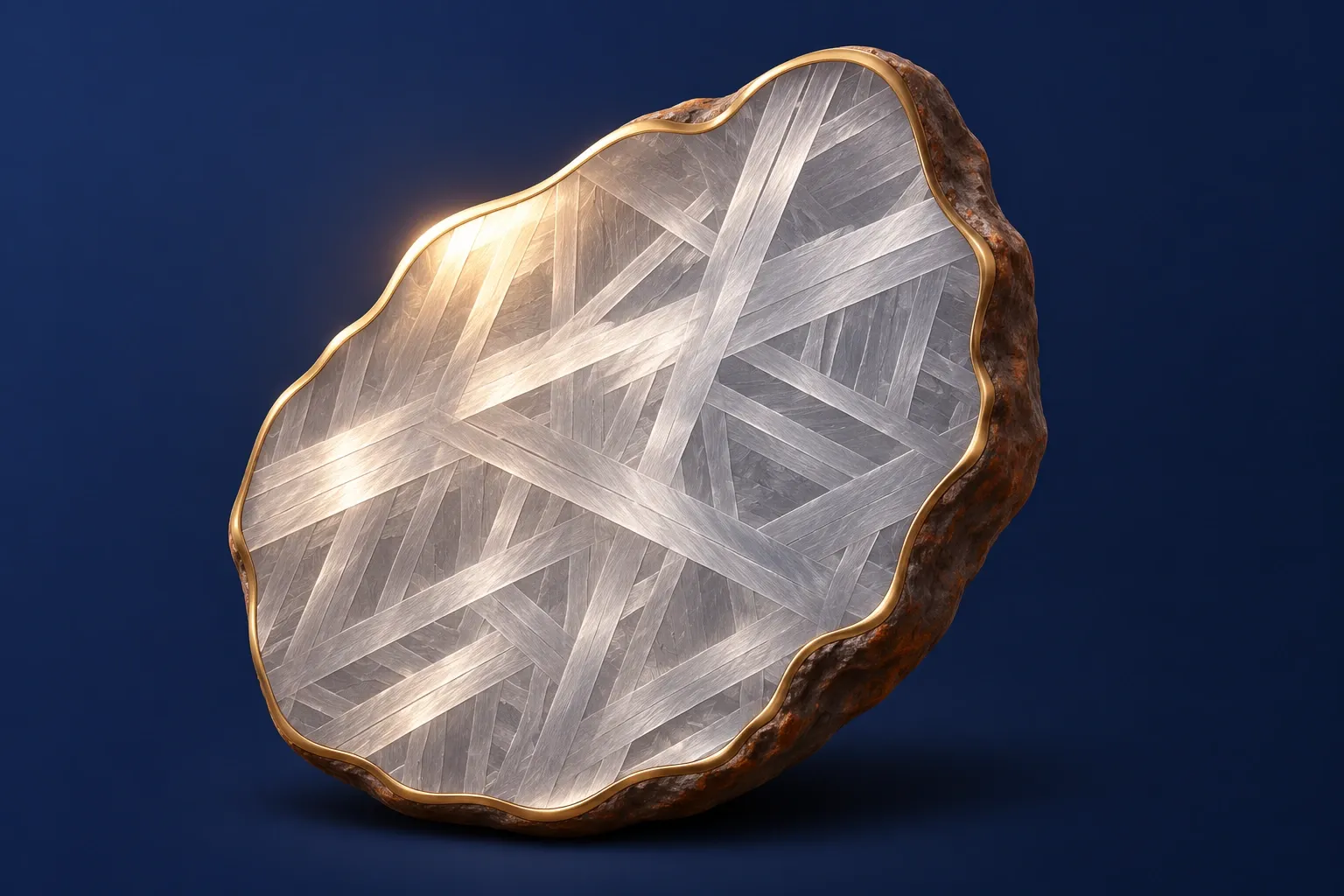
Sawn, polished and then etched with acid, most iron meteorites reveal a network of crisscrossing bands called the Widmanstätten pattern. It’s a telltale signature, but it’s a job for a lab, not a test to try at home.
A compass rather than a magnet
Their metal makes most meteorites magnetic. But don’t bring a magnet near a rock you think came from space: even a simple fridge magnet erases part of its magnetic memory, which is valuable to researchers. A gentler check is to hold the rock near a compass instead: if the needle moves, the rock contains metal.
It’s only a clue. Plenty of Earth rocks deflect a compass, starting with magnetite, and many dark basalts contain it.
Rocks that look like meteorites
Among the classic mix-ups, which turn up again and again in the photos people send to meteorite experts:
- Slag. These leftovers from metalworking look all sorts of ways, and some contain metal. But they are often glassy and full of bubbles, whereas meteorites rarely have any.
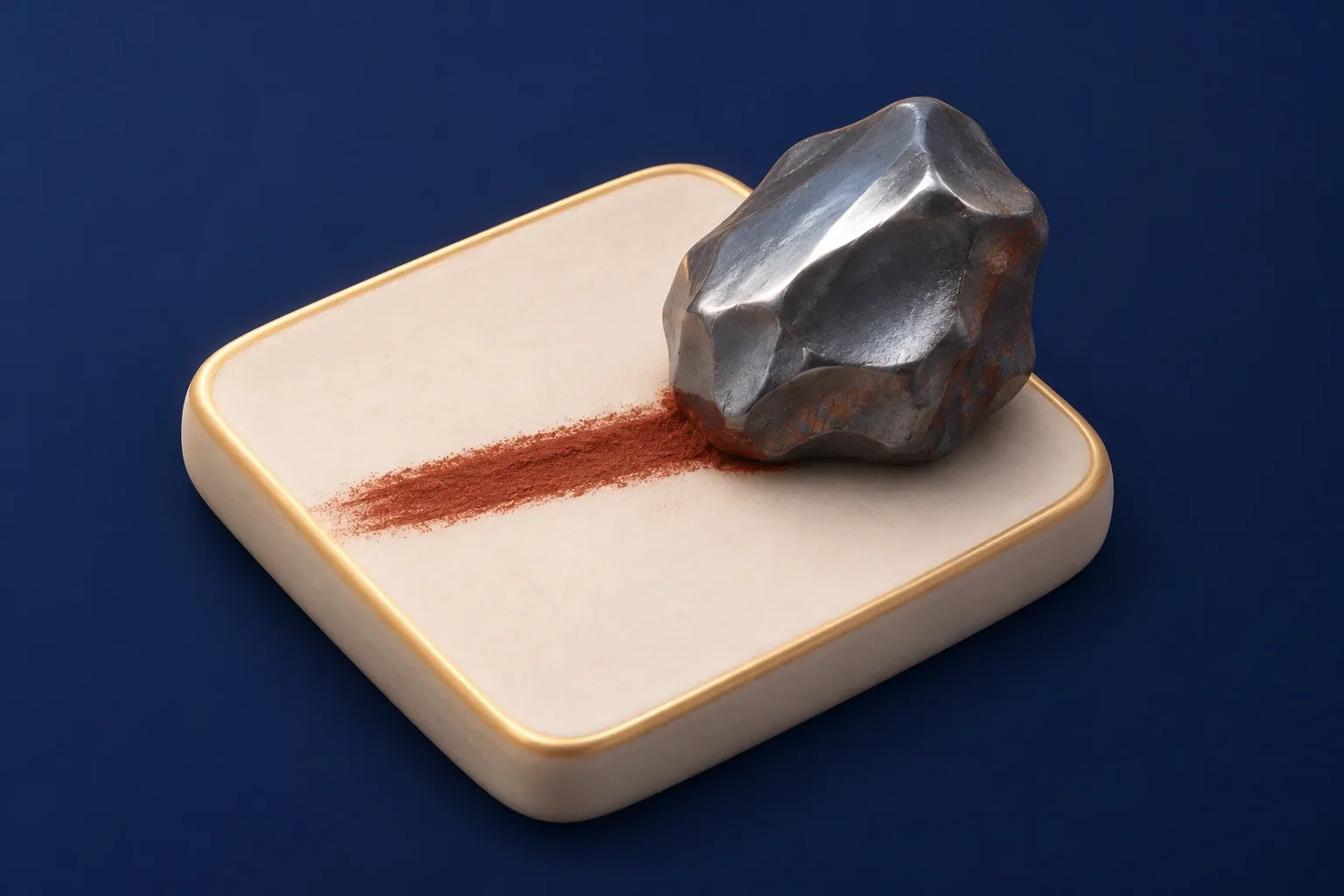
- Magnetite. Black, heavy and strongly magnetic, it often fools people. Rubbed on the back of an unglazed porcelain tile, it leaves a black streak.
- Hematite. Heavy and dark gray, it leaves a reddish-brown streak instead, and it is only weakly magnetic.
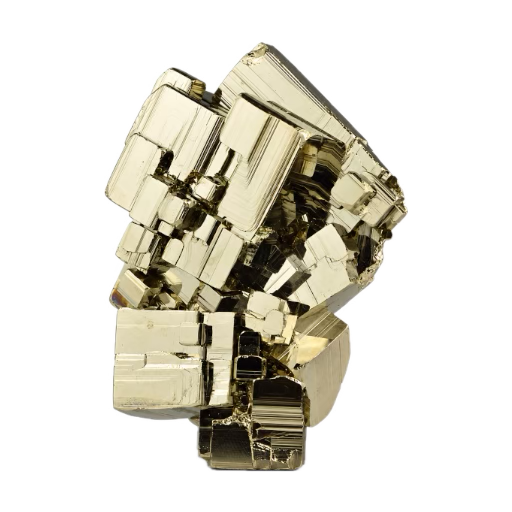
- Marcasite nodules. These balls of iron sulfide, a cousin of pyrite, form in chalk and other sedimentary rocks. Broken open, they show a radiating structure, never chondrules.
- Basalt and obsidian. Dark too, but with no grains of shiny metal and no fusion crust. A black, glassy chip picked up in a field may also be glass or industrial waste rather than obsidian.
What Kaillou can tell you
Take a photo of your rock with Kaillou: the app covers meteorites and their common look-alikes, such as magnetite, hematite or slag, and its meteorite page explains how to tell them apart. It’s a lead to guide what you look for, not a verdict: a photo alone cannot confirm a meteorite, although an expert can sometimes rule one out from clear photos. Confirmation requires examining the rock and, when needed, laboratory testing.
You think you found a meteorite
- Don’t clean it, break it or get it wet, and handle it as little as possible. Iron meteorites rust in damp air: keep it dry, in a clean bag.
- Write down where and when you found it, weigh it, measure it and take photos.
- Ask before you mail anything. There is no national office in the US that examines rocks from the public. Arizona State University’s Buseck Center for Meteorite Studies suspended its public identification program in 2010 and no longer accepts samples. It suggests contacting your state geological survey, the geology department of a local university or college, or your local natural history museum.
- Start with photos. Washington University in St. Louis runs a meteorite identification site with a self-test checklist. Once you have gone through it, its volunteer expert will look at a few photos of the whole rock sent by email, with a hand, coin or ruler for scale. Don’t mail samples: they won’t be returned. It doesn’t appraise rocks, and it advises sending photos before paying anyone for testing.
If you see a fireball, you can report it to the American Meteor Society. Its online form pools eyewitness accounts, and it alerts planetary scientists when an event looks promising. Weather radar helps too: on April 22, 2012, an asteroid broke up over California’s Sierra Nevada, and Doppler weather radar data guided searchers to the area around Coloma and Lotus, where they recovered 77 small meteorites. Named Sutter’s Mill, it turned out to be a rare carbonaceous chondrite.
If the rock is confirmed, the scientist who classifies it proposes a name, usually that of the place where it was found, and the Meteoritical Society’s Nomenclature Committee approves it. Without this authentication, a meteorite is worth little on the collectors’ market.
Finally, don’t assume a meteorite belongs to you because you found it. In general, US courts have held that a meteorite belongs to the owner of the land where it is found, so on private land you need the owner’s permission. On federal land, it depends on the agency:
- Bureau of Land Management (BLM) land: casual collecting is allowed without a permit, but only from the surface, without motorized or mechanized equipment (metal detectors are fine), up to 10 pounds (4.5 kg) per person per year, and for personal use only: you can’t sell or trade what you pick up. Some areas are closed, such as developed recreation sites, some national monuments and national conservation areas, and areas closed by a land use plan. Selling requires a commercial permit, and research a scientific one.
- National parks: collecting is not allowed.
- National forests: the BLM rules don’t apply, and rules are set forest by forest. Some, like Gifford Pinchot National Forest in Washington, prohibit collecting meteorites. Check with the local ranger district.
On state or tribal land, ask the agency that manages it before you pick anything up.
Famous American meteorites
The largest meteorite ever found in the United States is the Willamette meteorite, an iron of about 15.5 metric tons (34,000 lb) found near Oregon City in 1902. Its finder secretly moved it from land owned by a steel company onto his own, and in 1905 the Oregon Supreme Court ruled that it belonged to the company. It has been on display at the American Museum of Natural History in New York since 1906, and a 2000 agreement with the Confederated Tribes of the Grand Ronde Community of Oregon lets tribal members hold a private ceremony there each year. On November 30, 1954, a meteorite of about 8.5 pounds (3.9 kg) crashed through the roof of a house near Sylacauga, Alabama, bounced off a radio and struck Ann Hodges on the hip: she is the first person known to have been injured by a meteorite. Her landlord sued to claim the rock, a settlement left it with the Hodges, and it is now on display at the Alabama Museum of Natural History in Tuscaloosa. And meteoritic iron was used long before people knew how to smelt iron from ore: the blade of a dagger found in Tutankhamun’s tomb is made of it.
To find out what a rock that didn’t fall from the sky is worth, read how to tell if a rock is valuable.
Sources
- Signaler une possible météorite (Report a possible meteorite), Muséum national d’histoire naturelle (in French)
- Simple hand magnets erase a meteorite’s magnetic memory, MIT News, 2023
- Comment reconnaître une météorite ? (How to recognize a meteorite), Xavier Demeersman, Futura, 2021 (in French)
- Meteorite, Wikipedia
- Density and specific gravity, Caveat emptor, Some meteorite realities, Meteorite numbers in the United States, Canada, and Mexico, Meteorwrongs, Self-test checklist, What to do if you think you have found a meteorite and How are meteorites named?, Meteorite Identification, Washington University in St. Louis
- FAQ: sample identification, Buseck Center for Meteorite Studies, Arizona State University
- Collection of Meteorites on Public Land, IM 2012-182 and its FAQs on Meteorites on Public Land, Bureau of Land Management, 2012
- Recreational collection of rocks and minerals: legal instruments, National Park Service
- Minerals and rocks, Gifford Pinchot National Forest, USDA Forest Service
- Fireballs, American Meteor Society
- NASA researchers strike scientific gold with meteorite, EarthSky, via NASA Ames Research Center, 2012
- Willamette Meteorite, Wikipedia
- Hodges Meteorite Strike (Sylacauga Aerolite), Encyclopedia of Alabama
- Magnetite, Hematite and Marcasite, Wikipedia
- Tutankhamun’s meteoric iron dagger, Wikipedia