Kaillou

Pyrite
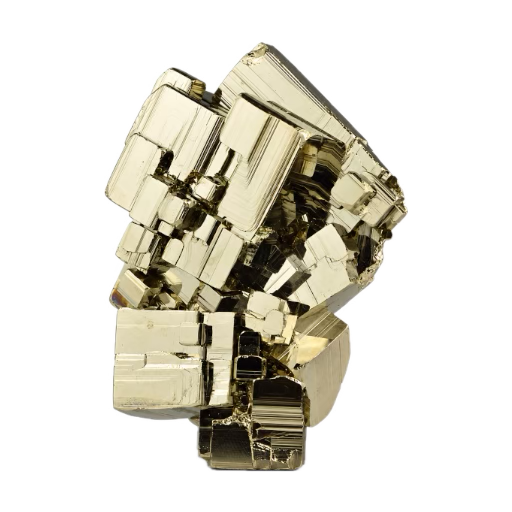
Pyrite is an iron sulfide and the most common sulfide mineral. Its metallic shine and brass color earned it the nickname fool's gold.
How to identify pyrite
Pale brass-yellow, with sharp cubes or many-sided crystals, often with fine parallel lines on the faces. It leaves a greenish-black mark on unglazed porcelain, and it breaks instead of bending.
Real or fake pyrite: common imitations
How much is pyrite worth?
At average quality, a walnut-sized rough piece (about 74 g) is worth $3 to $7; a 1 kg rough piece, $30 to $56; an egg-sized crystal (about 248 g), $21 to $65.
| Specimen | Ordinary | Average | Fine |
|---|---|---|---|
| Rough piece, walnut-sizedabout 74 g | $2 to $5 | $3 to $7 | $6 to $12 |
| Rough piece, 1 kg | $20 to $36 | $30 to $56 | $51 to $95 |
| Crystal, egg-sizedabout 248 g | $10 to $28 | $21 to $65 | $56 to $170 |
Ordinary quality: dull, opaque or chipped. Fine quality: vivid color, clean and translucent stone.
An ordinary piece is worth a few dollars at best. Crystals set the price: sharp, shiny cubes of good size with no sign of alteration. The finest Spanish specimens sell to collectors for their shape, not for their metal.
These figures are orders of magnitude from Kaillou’s calculator: an estimate, not an appraisal. For a piece that looks exceptional, ask a gemologist. How the calculator works.
Where to find pyrite
Almost everywhere: in quartz veins, sedimentary and metamorphic rock, coal beds, and replacing the shell of fossils. Spain and Peru are known for fine crystals.
In France, one of the great deposits lies west of Lyon, at Sain-Bel and Saint-Pierre-la-Palud. Worked from the Middle Ages for copper, it later supplied pyrite to make sulfuric acid, until it closed in 1972 after about 18 million tonnes. The Perret shaft, protected as a historic monument, and a mining museum keep its memory alive. In the Isère, the Mésage mine is well known to collectors.
Good to know
Damp air can slowly break it down into a white powder and sulfuric acid. Specimens are best stored dry, and those showing this powder are best kept away from other stones.
Pyrite history
Its name comes from the Greek for fire, because it throws sparks when struck against steel. It was later used in wheel-lock guns and as a source of sulfur.