Kaillou

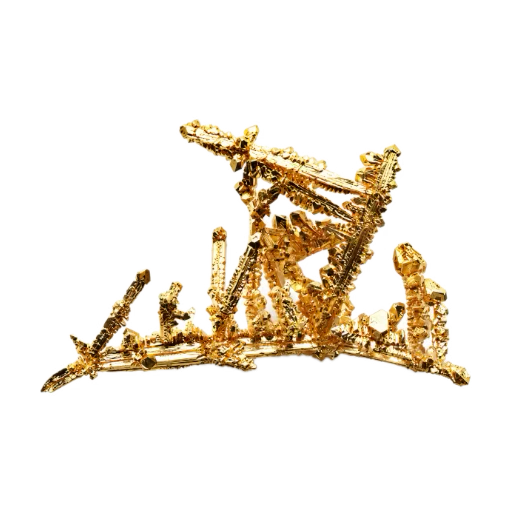
Gold
Gold is a soft, heavy metal that stays bright because it almost never reacts with air or water. It usually occurs as native metal, in grains or nuggets, often alloyed with a little silver.
How to identify gold
A warm, buttery yellow that stays the same from every angle. It bends or dents instead of breaking, and it feels far too heavy for its size.
Real or fake gold: common imitations
- Pyrite
- Paler and brassy, often in sharp cubes. It shatters when struck, while gold flattens.
- Mica flakes
- Glitter in sand but weigh almost nothing. Gold flakes sink at once and stay at the bottom of a pan.
How much is gold worth?
At average quality, a 1 g nugget is worth $190 to $260; a 10 g nugget, $1,900 to $2,600.
| Specimen | Ordinary | Average | Fine |
|---|---|---|---|
| 1 g nugget | $160 to $210 | $190 to $260 | $240 to $320 |
| 10 g nugget | $1,600 to $2,100 | $1,900 to $2,600 | $2,400 to $3,200 |
Ordinary quality: dull, opaque or chipped. Fine quality: vivid color, clean and translucent stone.
Gold is sold by weight, based on its purity and the current market price. Native gold contains other metals, and a buyer pays only for the gold actually present. A fine nugget may command a collector’s premium above the value of its gold content. The flakes from a day on a river weigh so little that they are mostly worth keeping as a souvenir.
These figures are orders of magnitude from Kaillou’s calculator: an estimate, not an appraisal. For a piece that looks exceptional, ask a gemologist. How the calculator works.
Where to find gold
In quartz veins, and in the gravel of rivers downstream from them, where its weight makes it settle. China, Russia and Australia are the largest producers today.
In France, the great gold mine was Salsigne, in the Aude, which produced about 120 tonnes of gold before closing in 2004. Today gold is mostly sought as flakes in certain rivers, such as the Gardon, in the Gard, or the Salat, in the Ariège.
Good to know
Recreational gold panning is governed by prefectural orders in France, so it is best to check with the prefecture before heading out with a pan. It may require a declaration, be limited to certain rivers or certain months, or be banned. In the Ariège, for instance, it has been limited to one stretch of the Salat, from May to October. On private land, the owner’s consent is needed. The surroundings of old mines are best avoided too: the Orbiel valley, below Salsigne, is still polluted with arsenic.
Gold history and lore
One of the first metals people worked. Objects from the Varna graves in Bulgaria date to the 5th millennium BC. It is still used for jewelry, coins and electronics.
In Greek myth, everything King Midas touched turned to gold, including his food.