Kaillou

Vivianite
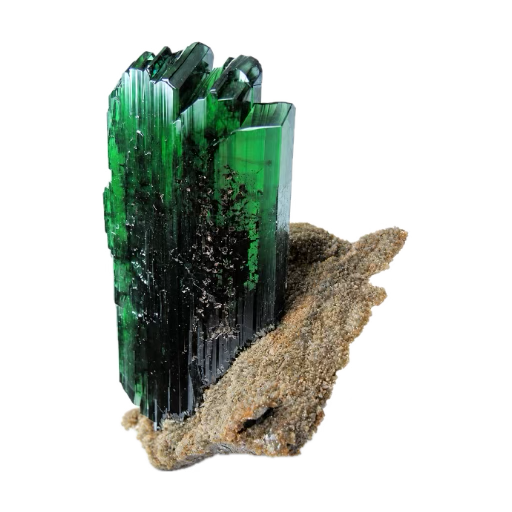
Vivianite is a hydrated iron phosphate that forms soft, glassy crystals. Pure crystals are colorless, but they oxidize easily and turn blue to blue-green.
How to identify vivianite
Slender, flattened prisms in deep blue to bluish green, or earthy crusts that start whitish and darken. It is very soft and scratches easily. Thin pieces split into flexible flakes.
Real or fake vivianite: common imitations
How much is vivianite worth?
At average quality, a walnut-sized rough piece (about 40 g) is worth $9 to $23; a 1 kg rough piece, $120 to $300; an egg-sized crystal (about 134 g), $57 to $220.
| Specimen | Ordinary | Average | Fine |
|---|---|---|---|
| Rough piece, walnut-sizedabout 40 g | $5 to $12 | $9 to $23 | $19 to $46 |
| Rough piece, 1 kg | $75 to $160 | $120 to $300 | $260 to $600 |
| Crystal, egg-sizedabout 134 g | $25 to $81 | $57 to $220 | $180 to $700 |
Ordinary quality: dull, opaque or chipped. Fine quality: vivid color, clean and translucent stone.
Everything rests on the crystals: long, intact prisms, translucent and a deep blue-green, are worth far more than an earthy crust. In light, vivianite gradually darkens to a blackish violet, and its thin flexible blades split at the slightest knock: a fine, well-preserved specimen remains rare. The most remarkable come notably from Bolivia and Cameroon. A blue crust found in clay or on a fossil is mostly a curiosity.
These figures are orders of magnitude from Kaillou’s calculator: an estimate, not an appraisal. For a piece that looks exceptional, ask a gemologist. How the calculator works.
Where to find vivianite
In clay, peat bogs, iron-rich sediments, and inside fossil shells and bones. Fine crystals come from Bolivia and Cornwall in England.
Good to know
Light and air darken the color, and the crystals are soft and easily damaged. Specimens are best stored in the dark.
Vivianite history
The German geologist Abraham Gottlob Werner named it in 1817, after either a Cornish mine owner or an English mineralogist named Vivian. It was first found at Wheal Kitty in Cornwall, and earthy forms were once used as a blue pigment.