Kaillou

Rubellite
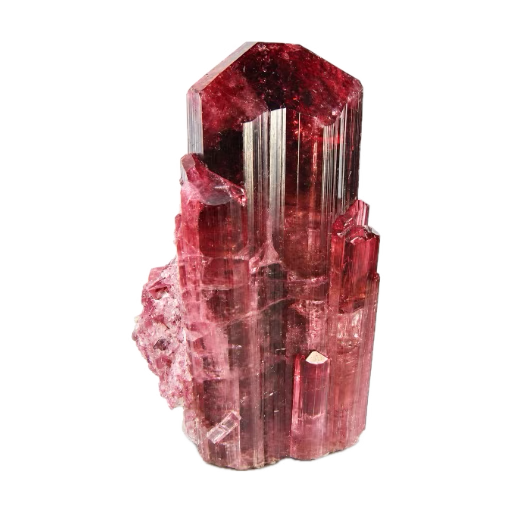
Rubellite is the red to pink variety of tourmaline, belonging to the elbaite species. It is sometimes confused with ruby.
How to identify rubellite
Raspberry red to pink, glassy, with slightly rounded triangular crystals marked by lengthwise lines. Thin cracks and tubes are common inside. Seen from different angles, the color changes in depth.
Real or fake rubellite: common imitations
- Ruby
- Harder, and usually without long thin tubes. Most rubies glow red under ultraviolet light.
- Red glass
- Shows round bubbles and has no color change by angle.
How much is rubellite worth?
At average quality, a walnut-sized rough piece (about 45 g) is worth $12 to $35; a 1 kg rough piece, $140 to $410; a 1-carat cut stone, $96 to $210.
| Specimen | Ordinary | Average | Fine |
|---|---|---|---|
| Rough piece, walnut-sizedabout 45 g | $6 to $16 | $12 to $35 | $29 to $85 |
| Rough piece, 1 kg | $75 to $190 | $140 to $410 | $350 to $1,100 |
| Crystal, egg-sizedabout 150 g | $27 to $110 | $70 to $340 | $270 to $1,300 |
| Cut stone, 1 carat0.2 g | $61 to $120 | $96 to $210 | $180 to $380 |
Ordinary quality: dull, opaque or chipped. Fine quality: vivid color, clean and translucent stone.
Color accounts for most of the price: a vivid red is worth far more than a pale pink. Visible inclusions are common and accepted when the color is beautiful, but a stone that looks clean to the eye is more sought after. The price per carat climbs for large stones. Some pink tourmalines are irradiated to deepen their color, often in a way that cannot be detected, and fractures can be filled with oil or resin. An opaque crystal is not worth what a gem is.
These figures are orders of magnitude from Kaillou’s calculator: an estimate, not an appraisal. For a piece that looks exceptional, ask a gemologist. How the calculator works.
Where to find rubellite
In granite pegmatites. Brazil, Madagascar, Nigeria, Afghanistan, Russia and the United States are known sources.
In France, elbaite, the tourmaline species of which rubellite is the red to pink variety, is reported at Chédeville, in the commune of Ambazac, in the Haute-Vienne, in west-central France. It was found there with schorl, a black tourmaline, in prospecting trenches from the 1960s, within a petalite pegmatite, petalite being a lithium mineral. This deposit was mostly worked for lepidolite. The site is protected: collecting minerals there is forbidden, except by special permit for scientific or teaching purposes.
Rubellite history and lore
The name has been used since 1794 and comes from the Latin for reddish. Around 1900 the Chinese imperial court bought large amounts of pink tourmaline from California.
Tourmaline is a birthstone of October.