Kaillou


Pyrope
Pyrope is a magnesium-aluminum garnet with a deep red color in most natural stones. Its name comes from Greek words for fire and eye.
How to identify pyrope
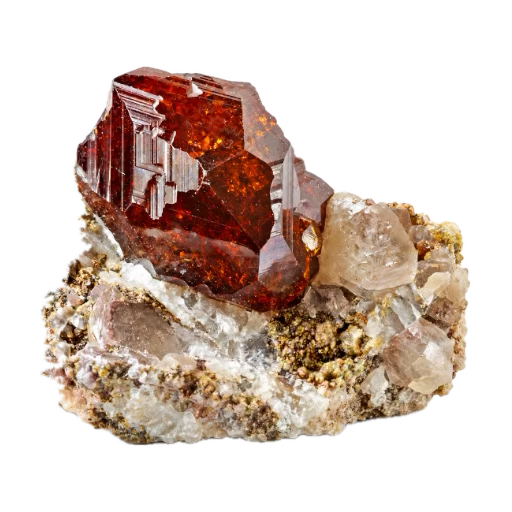
Deep, clear red, sometimes slightly orange or purple, glassy, usually in rounded grains rather than sharp crystals. Few inclusions are visible. It scratches glass.
Real or fake pyrope: common imitations
How much is pyrope worth?
At average quality, a walnut-sized rough piece (about 53 g) is worth $3 to $8; a 1 kg rough piece, $36 to $84; a 1-carat cut stone, $13 to $25.
| Specimen | Ordinary | Average | Fine |
|---|---|---|---|
| Rough piece, walnut-sizedabout 53 g | $2 to $5 | $3 to $8 | $7 to $17 |
| Rough piece, 1 kg | $22 to $46 | $36 to $84 | $75 to $180 |
| Crystal, egg-sizedabout 175 g | $8 to $28 | $20 to $76 | $63 to $240 |
| Cut stone, 1 carat0.2 g | $8 to $16 | $13 to $25 | $22 to $42 |
Ordinary quality: dull, opaque or chipped. Fine quality: vivid color, clean and translucent stone.
Color accounts for most of the price: a bright, luminous red is worth more than a red so dark that it looks almost black. Pyrope is usually clean to the eye, so a visible inclusion lowers its value clearly. Quality of cut and weight come next. Red glass is sometimes used as an imitation. An ordinary grain picked up in alluvial gravel, small or cracked, has hardly any market value.
These figures are orders of magnitude from Kaillou’s calculator: an estimate, not an appraisal. For a piece that looks exceptional, ask a gemologist. How the calculator works.
Where to find pyrope
In rocks from the deep mantle brought up by volcanic pipes, such as diamond-bearing kimberlite. Czech Bohemia, South Africa and the American Southwest are known sources.
Pyrope history and lore
Bohemian pyrope jewelry was very popular in 19th-century Europe. Prospectors use pyrope grains as a clue to find diamond-bearing rock.
As a garnet, it is a birthstone of January.