Kaillou


Moissanite
Moissanite is silicon carbide, a mineral so rare in nature that gems sold today are lab-grown. It is extremely hard, just below diamond.
How to identify moissanite
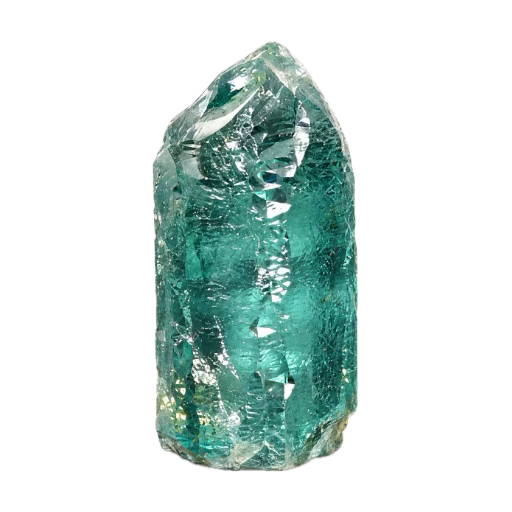
Colorless to pale green or yellow, with strong rainbow flashes, more intense than in a diamond. Under a loupe, looking at an angle through the side facets, the back edges appear doubled. It is much too hard for ordinary scratch tests.
Real or fake moissanite: common imitations
- Diamond
- The back facets do not look doubled. Moissanite can fool simple thermal testers: an electrical test gives a clue but cannot settle it alone.
- Cubic zirconia
- Heavier for its size and softer. It shows fewer flashes of color.
How much is moissanite worth?
At average quality, a walnut-sized rough piece (about 48 g) is worth $19 to $50; a 1 kg rough piece, $220 to $570; a 1-carat cut stone, $36 to $93.
| Specimen | Ordinary | Average | Fine |
|---|---|---|---|
| Rough piece, walnut-sizedabout 48 g | $11 to $25 | $19 to $50 | $44 to $120 |
| Rough piece, 1 kg | $120 to $290 | $220 to $570 | $500 to $1,300 |
| Crystal, egg-sizedabout 161 g | $47 to $170 | $110 to $490 | $400 to $1,700 |
| Cut stone, 1 carat0.2 g | $20 to $46 | $36 to $93 | $81 to $210 |
Ordinary quality: dull, opaque or chipped. Fine quality: vivid color, clean and translucent stone.
All commercial moissanites come out of a factory: their price depends mostly on weight, tint and cut quality. A colorless stone is worth more than one with yellow or green flashes. They cost far less than a diamond of the same size. Natural moissanite exists only as tiny grains, of no interest for jewelry. Sold as diamond, it amounts to fraud: some stones even carry a fake certificate number engraved on them.
These figures are orders of magnitude from Kaillou’s calculator: an estimate, not an appraisal. For a piece that looks exceptional, ask a gemologist. How the calculator works.
Where to find moissanite
In nature only as tiny grains in kimberlite, in meteorites and in a few rocks such as the Green River Formation in Wyoming. Gems come from factories, not from mines.
Good to know
It changes color slightly when heated, from about 65 °C (149 °F). This thermochromism and its electrical conductivity help tell it from diamond, since simple thermal testers confuse the two.
Moissanite history
Henri Moissan found it in 1893 in rock from the Canyon Diablo meteorite crater in Arizona and first took it for diamond. Lab-grown gems reached the jewelry market in 1998.