Kaillou

Larvikite
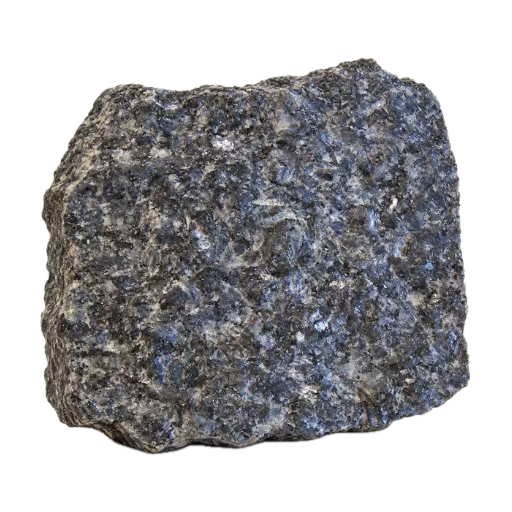
Larvikite is a dark gray igneous rock, a type of monzonite, named after the town of Larvik in Norway. Its large feldspar crystals flash silvery blue.
How to identify larvikite
Dark gray to bluish-black stone with thumbnail-size feldspar crystals that flash blue or silver as it is turned. It is coarse-grained and speckled with dark minerals. Polished surfaces show the flashes best.
Real or fake larvikite: common imitations
- Labradorite
- Also flashes blue, but it is a single mineral with a wider range of flash colors. Larvikite is a coarse rock with many flashing grains.
How much is larvikite worth?
At average quality, a walnut-sized rough piece (about 41 g) is worth $1 to $2; a 1 kg rough piece, $8 to $16.
| Specimen | Ordinary | Average | Fine |
|---|---|---|---|
| Rough piece, walnut-sizedabout 41 g | under $1 | $1 to $2 | $1 to $3 |
| Rough piece, 1 kg | $5 to $10 | $8 to $16 | $14 to $27 |
Ordinary quality: dull, opaque or chipped. Fine quality: vivid color, clean and translucent stone.
Raw, an ordinary larvikite finds no buyer: it is extracted in large blocks for construction. The prices in the table are those of polished stones sold by dealers. Everything depends on the reflections: an intense blue is worth more than a weak or silvery sheen, and veins, cracks or spots quickly bring the price down. At the quarry, about nine out of every ten cubic meters are not used as dimension stone. An unpolished water-worn piece keeps only faint reflections.
These figures are orders of magnitude from Kaillou’s calculator: an estimate, not an appraisal. For a piece that looks exceptional, ask a gemologist. How the calculator works.
Where to find larvikite
In the Larvik area of southern Norway, where many quarries work it, and in a small area near Thunder Bay in Ontario.
Its quarries are in Norway, at Larvik and, to a lesser extent, at Porsgrunn. France is nevertheless, with China and Spain, among the countries that import the most of it. It is therefore seen mostly polished, on facades, as wall cladding, in slabs or on gravestones, where the polish shows off its blue reflections.
Larvikite history
It formed about 295 million years ago from magma in the Oslo Rift. Today it is widely used as facing stone and countertops, sold under trade names such as Blue Pearl.