Kaillou


Granite
Granite is a coarse igneous rock that forms when magma cools slowly deep underground. It is one of the main rocks of the continents.
How to identify granite
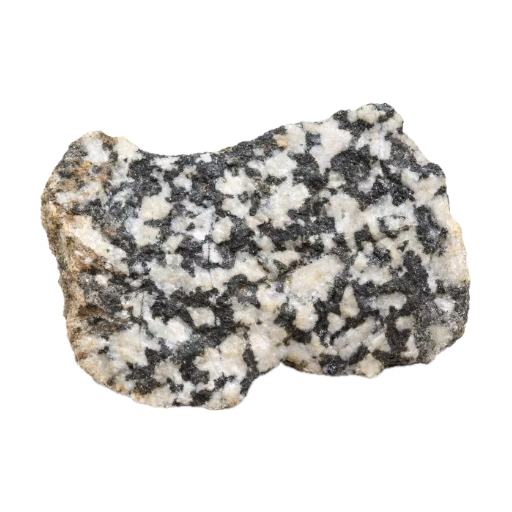
Visible interlocking grains of glassy gray quartz, white or pink feldspar and black specks of mica. The grains are scattered evenly. A similar rock with bands is probably gneiss.
How much is granite worth?
At average quality, a walnut-sized rough piece (about 39 g) is worth under $1; a 1 kg rough piece, $6 to $10.
| Specimen | Ordinary | Average | Fine |
|---|---|---|---|
| Rough piece, walnut-sizedabout 39 g | under $1 | under $1 | $1 to $2 |
| Rough piece, 1 kg | $5 to $8 | $6 to $10 | $9 to $14 |
Ordinary quality: dull, opaque or chipped. Fine quality: vivid color, clean and translucent stone.
A piece of granite picked up outdoors finds no buyer: the few dollars in the table match the price of a labeled specimen, with its provenance, sold in a shop. The price of building granite comes from quarrying, cutting and laying it, not from the rock itself. It interests a collector only if it contains large crystals or a rare mineral.
These figures are orders of magnitude from Kaillou’s calculator: an estimate, not an appraisal. For a piece that looks exceptional, ask a gemologist. How the calculator works.
Where to find granite
On every continent, especially in mountain ranges and old eroded plateaus, where it forms domes and rounded blocks. Beach and river pebbles are also common.
In France, it is found in Brittany, the Massif Central, the Vosges and Corsica. Two sites stand out. On the Pink Granite Coast, around Ploumanac’h, the massif was emplaced about 300 million years ago, and its color comes from a pink feldspar. The Sidobre, in the Tarn, supplies about 65% of French granite and has chaotic fields of boulders such as the Peyro Clabado, a balanced rock of about 780 tonnes.
Good to know
Granitic ground gives off radon, a naturally occurring radioactive gas that can build up in poorly ventilated homes. The issue concerns the ground and indoor air, not a stone sitting on a shelf.
Granite history
Quarried since ancient Egypt, notably for obelisks and temples. Today it is used for buildings, paving, monuments and kitchen countertops.