Kaillou


Flint
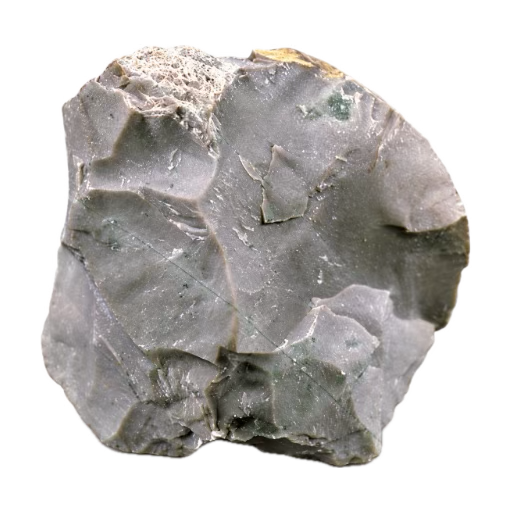
Flint is a hard, fine-grained form of silica found as lumps in chalk and limestone. It is a kind of chert that breaks into very sharp edges.
How to identify flint
A dark gray to black lump with a rough, chalky white rind. Inside it is smooth, glassy to waxy, and breaks with curved, shell-like scars. It scratches glass and throws sparks when struck on steel.
Real or fake flint: common imitations
- Other chert
- Same family, but usually duller, lighter and grainier, and not found in chalk.
- Obsidian
- Volcanic glass that is shinier and softer, with smoky translucent edges.
- Ferrocerium
- The man-made metal rod called a flint in lighters and fire steels.
How much is flint worth?
At average quality, a walnut-sized rough piece (about 39 g) is worth under $1; a 1 kg rough piece, $8 to $12.
| Specimen | Ordinary | Average | Fine |
|---|---|---|---|
| Rough piece, walnut-sizedabout 39 g | under $1 | under $1 | $1 to $2 |
| Rough piece, 1 kg | $6 to $10 | $8 to $12 | $11 to $16 |
Ordinary quality: dull, opaque or chipped. Fine quality: vivid color, clean and translucent stone.
A flint picked up in a field finds no buyer: the few dollars in the table match the price of a labeled specimen sold in a shop. Its real value lies elsewhere: a prehistoric tool is most informative to archaeologists when its exact findspot is known, and it loses that value once removed from its context.
These figures are orders of magnitude from Kaillou’s calculator: an estimate, not an appraisal. For a piece that looks exceptional, ask a gemologist. How the calculator works.
Where to find flint
In chalk and limestone beds, and on beaches and fields where these rocks have eroded. Southern England, northern France, Denmark and Poland are well known, as is Flint Ridge in Ohio.
In France, two regions marked its history. Around Le Grand-Pressigny, in the Indre-et-Loire, workshops of the Late Neolithic exploited the large blocks of flint in the local chalk. At Meusnes and Couffy, in the Loir-et-Cher, flint for gunflints was mined for centuries, at depths of 10 to 20 meters.
Good to know
Fresh breaks are razor sharp, and heated flint can burst. If you come across tools or remains, it is best not to dig: in France, an archaeological find must be reported to the mayor of the commune.
Flint history and lore
Used for stone tools since the Stone Age, because it splits into sharp flakes, and later struck against steel to make fire. Flintlock guns relied on it until the 19th century, and builders in southern England set it into church and house walls.
Ohio has named flint its official gemstone, and Flint Ridge was a major source for Native American toolmakers.