Kaillou

Shale
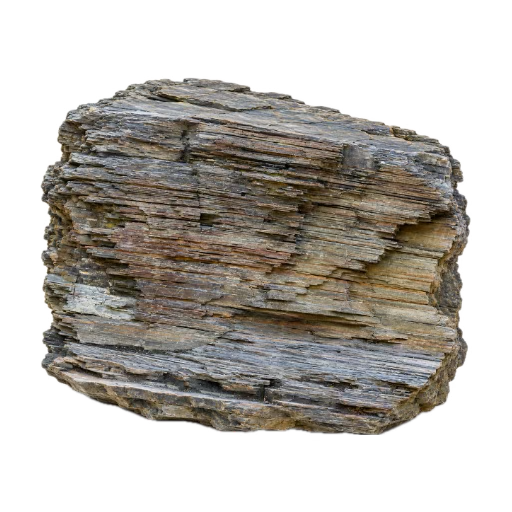
Shale is a soft, fine-grained sedimentary rock made of compacted mud, mostly clay minerals with tiny grains of quartz. It is the most common sedimentary rock.
How to identify shale
Dull gray, black, brown, red or green, splitting into thin, flat, brittle plates along its layers. The grains are too small to see. A fingernail or coin can scratch it, and weathered pieces crumble in the hand.
Real or fake shale: common imitations
- Slate
- Metamorphic, harder and denser, and it splits into smooth sheets that ring when tapped.
- Mudstone
- Same material, but it breaks in blocky chunks instead of thin plates.
How much is shale worth?
At average quality, a walnut-sized rough piece (about 36 g) is worth under $1; a 1 kg rough piece, $6 to $10.
| Specimen | Ordinary | Average | Fine |
|---|---|---|---|
| Rough piece, walnut-sizedabout 36 g | under $1 | under $1 | under $1 |
| Rough piece, 1 kg | $5 to $7 | $6 to $10 | $8 to $13 |
Ordinary quality: dull, opaque or chipped. Fine quality: vivid color, clean and translucent stone.
A piece of shale picked up has no buyer: the prices in the table are those of samples sold in shops. As a material, it is mostly used to make bricks, tiles and cement, and is sold by the metric ton. For a collector, everything comes down to fossils: a sharp, complete imprint of known origin makes all the difference. A plate that is split or crumbling loses most of its interest.
These figures are orders of magnitude from Kaillou’s calculator: an estimate, not an appraisal. For a piece that looks exceptional, ask a gemologist. How the calculator works.
Where to find shale
In sedimentary basins on every continent, seen in road cuts, riverbanks and cliffs. Some layers hold fossils, and black shale is rich in organic matter.
Near Autun, in Saône-et-Loire, a basin of shales rich in organic matter, called oil shales, was mined to extract oil: extraction began in 1824 at Igornay, and the Télots mine, the last one, closed in 1957. Ruins and spoil heaps remain, notably at Dracy-Saint-Loup, Saint-Forgeot and Tavernay. The younger Toarcian “schistes-carton” (paper shales) are well known in the Paris and Aquitaine basins; at Saulx, in Haute-Saône, they yielded a fossil fish in 1883.
Shale history
Shale layers hold famous fossil beds, such as the Burgess Shale in Canada. It is also used to make bricks and cement, and some shale holds oil and gas.