 Kaillou

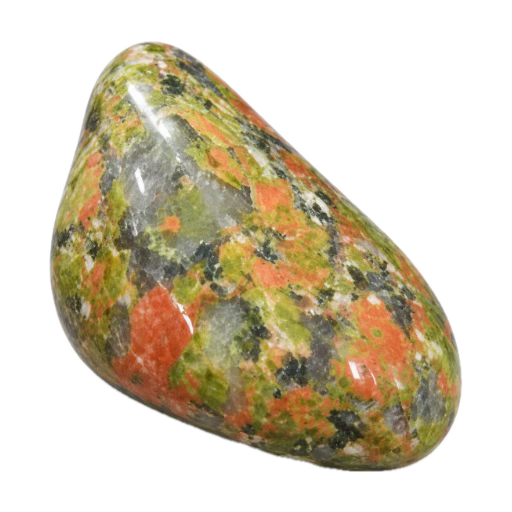
Unakite
Unakite is a coarse-grained rock that began as granite and was altered by hot fluids. It is named for the Unaka Range of the Appalachian Mountains.
How to identify unakite
Mottled pink and olive green, with some gray or clear patches. The pink is feldspar, the green is epidote and the clear parts are quartz. It is hard and takes a good polish.
How much is unakite worth?
At average quality, a walnut-sized rough piece (about 43 g) is worth $1 to $2; a 1 kg rough piece, $8 to $16.
| Specimen | Ordinary | Average | Fine |
|---|---|---|---|
| Rough piece, walnut-sizedabout 43 g | under $1 | $1 to $2 | $1 to $3 |
| Rough piece, 1 kg | $5 to $10 | $8 to $16 | $14 to $27 |
Ordinary quality: dull, opaque or chipped. Fine quality: vivid color, clean and translucent stone.
Raw, unakite finds no buyer: it is used mostly for beads, cabochons and inexpensive tumbled stones, and is not seen in fine jewelry. The prices in the table are those of stones sold by dealers. A fine piece has a fine grain, a well-balanced pink and green and no cracks. A rock that is almost all green, with no pink feldspar, is in fact an epidosite, often sold under the name unakite.
These figures are orders of magnitude from Kaillou’s calculator: an estimate, not an appraisal. For a piece that looks exceptional, ask a gemologist. How the calculator works.
Where to find unakite
In the Blue Ridge Mountains of the eastern United States, especially Virginia, North Carolina and Tennessee. It is found as boulders, outcrops and stream cobbles.
Good to know
Its minerals cleave easily: a knock can chip it. It is best reserved for jewelry that receives little wear, as it eventually wears down when worn in a ring or bracelet.
Unakite history
The geologist Bradley described and named it in 1874. It is now widely used for beads, cabochons and tumbled stones.


