Kaillou


Rhyolite
Rhyolite is a fine-grained or glassy volcanic rock very rich in silica. It is the lava equivalent of granite.
How to identify rhyolite
Pale pink, gray or tan, with a smooth base whose grains are too small to see. It often has scattered crystals of quartz or feldspar, and sometimes flow lines or small holes. A steel knife does not scratch it.
How much is rhyolite worth?
At average quality, a walnut-sized rough piece (about 36 g) is worth $1 to $2; a 1 kg rough piece, $7 to $15.
| Specimen | Ordinary | Average | Fine |
|---|---|---|---|
| Rough piece, walnut-sizedabout 36 g | under $1 | $1 to $2 | $1 to $2 |
| Rough piece, 1 kg | $5 to $10 | $7 to $15 | $13 to $25 |
Ordinary quality: dull, opaque or chipped. Fine quality: vivid color, clean and translucent stone.
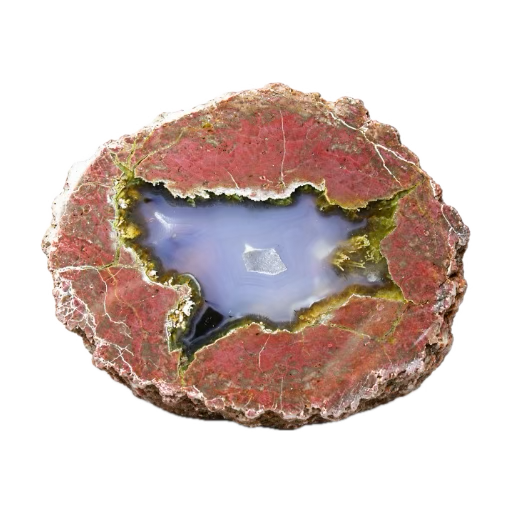
Raw, rhyolite finds no buyer: it is a common rock, used at best as building stone or road metal. Only a few pieces interest collectors: those whose polish reveals fine flow banding or spherulites, and thunderegg-type nodules, sought after for their agate or chalcedony core. The prices in the table are those of selected specimens sold in shops, not of a stone picked up on a path.
These figures are orders of magnitude from Kaillou’s calculator: an estimate, not an appraisal. For a piece that looks exceptional, ask a gemologist. How the calculator works.
Where to find rhyolite
In volcanic regions where silica-rich magma erupted, such as Yellowstone in Wyoming, Iceland and the North Island of New Zealand.
In France, the Esterel massif, between Saint-Raphaël (Var) and Mandelieu-la-Napoule (Alpes-Maritimes), on the Riviera, owes its reddish color to rhyolite formed by volcanic activity about 250 million years ago, during the Permian. It was quarried there as early as Antiquity to make millstones, notably at Bagnols-en-Forêt. The Morvan also has its rhyolites, older ones, such as those of Montreuillon, in the Nièvre. The heart of the Esterel is a protected site, and access to the massif is restricted in summer.
Rhyolite history
The name comes from a Greek word for a stream of lava, a nod to the flow banding it often shows. Rhyolite tuff is used as building stone, and obsidian, which is rhyolite glass, was used for blades.