Kaillou

Prehnite
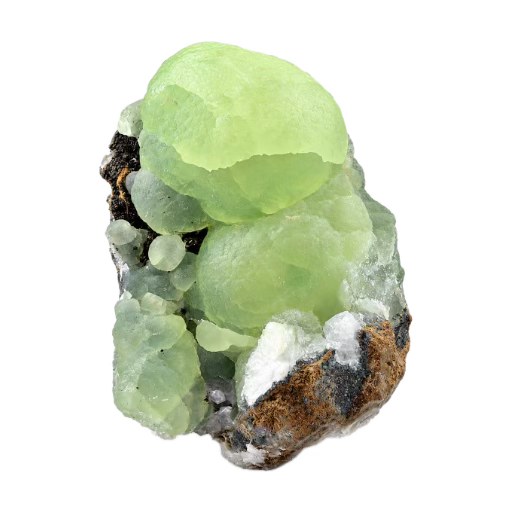
Prehnite is a calcium aluminum silicate that forms in cavities of basalt, usually as pale green rounded masses. Its color comes from small amounts of iron.
How to identify prehnite
Pale apple green to yellowish, with grape-like or kidney-shaped crusts and a glassy to pearly shine. It is translucent and brittle. White zeolite minerals often grow alongside.
Real or fake prehnite: common imitations
- Chrysoprase
- A green chalcedony that is harder, more waxy and more even in color.
- Glass
- Smooth and even, without the rounded crusts or cloudy zones.
How much is prehnite worth?
At average quality, a walnut-sized rough piece (about 42 g) is worth $2 to $5; a 1 kg rough piece, $29 to $61; an egg-sized crystal (about 140 g), $13 to $47.
| Specimen | Ordinary | Average | Fine |
|---|---|---|---|
| Rough piece, walnut-sizedabout 42 g | $1 to $3 | $2 to $5 | $4 to $9 |
| Rough piece, 1 kg | $18 to $36 | $29 to $61 | $55 to $120 |
| Crystal, egg-sizedabout 140 g | $6 to $19 | $13 to $47 | $40 to $140 |
Ordinary quality: dull, opaque or chipped. Fine quality: vivid color, clean and translucent stone.
Color and transparency set the price: a clear green and a very rare limpid material are worth far more than a pale, milky mass. Prehnite is cut mostly into cabochons; some material, notably from Australia, can also be faceted. For a collector, the shape of the crystals, their luster and the locality, such as the Oisans, count. An ordinary pale green crust broken off a basalt rarely finds a buyer.
These figures are orders of magnitude from Kaillou’s calculator: an estimate, not an appraisal. For a piece that looks exceptional, ask a gemologist. How the calculator works.
Where to find prehnite
In cavities and veins of basalt, and sometimes in granite and gneiss. Quarries in New Jersey, Scotland and South Africa are classic, and crystals come from Quebec and China.
The most renowned French deposit is the Combe-de-la-Selle, at Saint-Christophe-en-Oisans, in the Isère, in the French Alps. Its prehnites, collected since the 19th century from the clefts of an amphibolite, are among the best specimens known. In 1979, crystal hunters from Grenoble found a large pocket there at about 2,000 meters of altitude, now emptied. The upper valley lies in the core of the Écrins National Park, where collecting minerals is forbidden without permission. Prehnite is also reported in the Pyrenees, at the col d’Osquich (Pyrénées-Atlantiques) and in the Aure valley (Hautes-Pyrénées).
Prehnite history
It was named in the late 18th century for the Dutch commander Hendrik von Prehn, wrongly believed to have discovered it. The first specimens came from the Cape of Good Hope. It is sometimes cut as a cabochon or beads.