 Kaillou

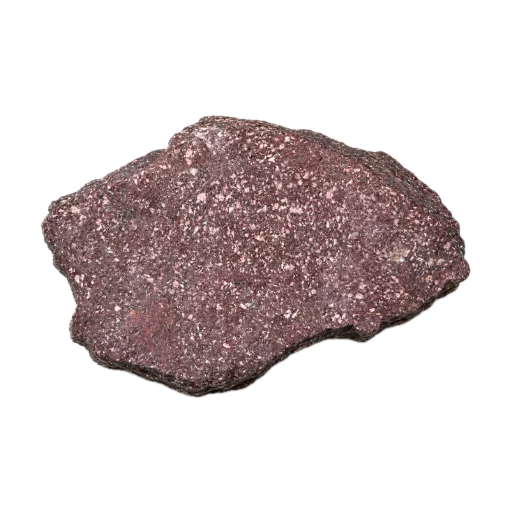
Porphyry
Porphyry is an igneous rock with large crystals set in a much finer-grained base. The word also names the traditional purple-red stone prized in ancient Rome.
How to identify porphyry
Pale, blocky crystals, often feldspar, scattered through a dark red, purple, brown or gray background. The two sizes of grain stand out clearly. It is hard and takes a high polish.
Real or fake porphyry: common imitations
- Granite
- Its grains are all of similar size and visibly interlocked, with no fine base around larger crystals.
How much is porphyry worth?
At average quality, a walnut-sized rough piece (about 39 g) is worth under $1; a 1 kg rough piece, $6 to $11.
| Specimen | Ordinary | Average | Fine |
|---|---|---|---|
| Rough piece, walnut-sizedabout 39 g | under $1 | under $1 | $1 to $2 |
| Rough piece, 1 kg | $5 to $8 | $6 to $11 | $9 to $16 |
Ordinary quality: dull, opaque or chipped. Fine quality: vivid color, clean and translucent stone.
A piece of porphyry picked up has no buyer: the prices in the table are those of samples sold in shops. Very hard, porphyry is mostly sold by weight, as setts, curbs, slabs or ballast. For a collector, what counts is the contrast between the crystals and the groundmass, a fine color and a sharp polish. Only objects carved from Egyptian imperial red porphyry belong to the art market, where everything depends on the piece and its history.
These figures are orders of magnitude from Kaillou’s calculator: an estimate, not an appraisal. For a piece that looks exceptional, ask a gemologist. How the calculator works.
Where to find porphyry
Wherever magma cools in stages, in lava flows and shallow intrusions around the world. The red Roman stone came from the Mons Porphyrites quarry in Egypt's Eastern Desert.
In the Var, the Estérel has its “blue porphyry,” esterellite: a pale, bluish rock dotted with white crystals, found only between Agay and Dramont, around Saint-Raphaël. The Romans already used it, and Roman columns of esterellite have been found at Fréjus. The Dramont quarries, active from 1864 to 1959, gave way to the Grands Caous quarry, active since 1959, which produces mostly ballast and riprap and can be visited by reservation. In Saint-Raphaël, the Maison des Carriers tells the story of the trade.
Porphyry history and lore
The name comes from the Greek word for purple. Roman and Byzantine emperors used the Egyptian red stone for columns and imperial tombs, and the quarry was forgotten until its rediscovery in 1823.
The phrase born in the purple comes from the Porphyra, a porphyry-lined chamber in Constantinople where Byzantine empresses gave birth.


