Kaillou


Olivine
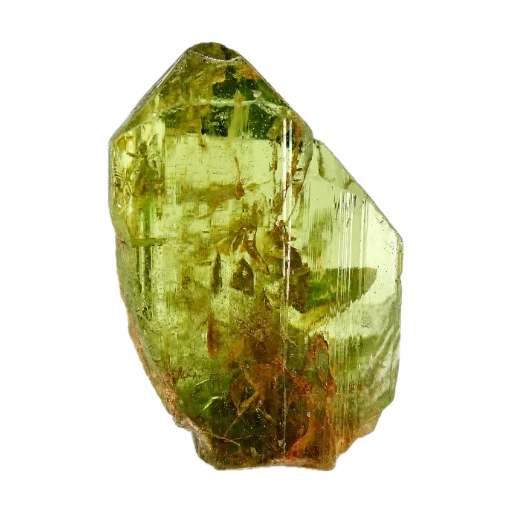
Olivine is a magnesium iron silicate and the main mineral of the Earth's upper mantle. Its composition runs between forsterite, rich in magnesium, and fayalite, rich in iron.
How to identify olivine
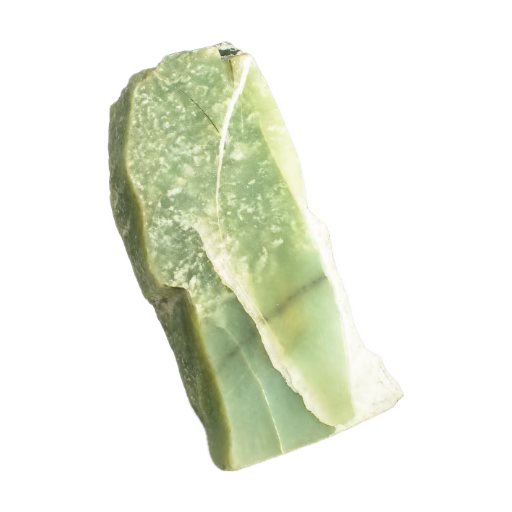
Olive-green, glassy grains, often small and rounded and packed together in dark volcanic rock such as basalt. It breaks with curved surfaces and has no obvious flat cleavage.
Real or fake olivine: common imitations
- Green glass
- Shows round bubbles. In real peridot, the back facet edges look doubled under a loupe.
- Green tourmaline
- Harder, and its color changes with the viewing angle. It does not show doubled edges as strongly.
How much is olivine worth?
At average quality, a walnut-sized rough piece (about 48 g) is worth $1 to $4; a 1 kg rough piece, $15 to $35; an egg-sized crystal (about 160 g), $7 to $30.
| Specimen | Ordinary | Average | Fine |
|---|---|---|---|
| Rough piece, walnut-sizedabout 48 g | $1 to $2 | $1 to $4 | $2 to $7 |
| Rough piece, 1 kg | $9 to $20 | $15 to $35 | $31 to $70 |
| Crystal, egg-sizedabout 160 g | $3 to $12 | $7 to $30 | $24 to $92 |
Ordinary quality: dull, opaque or chipped. Fine quality: vivid color, clean and translucent stone.
It all depends on gem quality. A clear peridot of a pure green with no brown tinge is worth far more than a pale or brownish stone; clarity, size and weight come next, since large stones without inclusions are rare. The small, cracked olivine grains in a basalt have only specimen value. Green glass is sometimes sold as peridot.
These figures are orders of magnitude from Kaillou’s calculator: an estimate, not an appraisal. For a piece that looks exceptional, ask a gemologist. How the calculator works.
Where to find olivine
In basalt and in rock fragments carried up from the mantle by volcanoes, and in some meteorites. Gem peridot comes from places such as Arizona and Pakistan.
In France, lherzolite, a mantle rock made of 40 to 90% olivine, takes its name from the Lherz massif in the Pyrenees of the Ariège. It crops out on the shore of the Étang de Lers, in the commune of Le Port, at 1,264 meters above sea level, one of its rare outcrops. In the Auvergne, in central France, remarkable olivine specimens come from the Beaunit maar in the Puy-de-Dôme, from around Langeac and Le Puy-en-Velay in the Haute-Loire, and from Allanche in the Cantal.
Olivine history and lore
Gem olivine, called peridot, was mined on an island in the Red Sea in antiquity. Today olivine is also used in metalworking and as foundry sand.
Peridot, the gem form of olivine, is the birthstone of August.