Kaillou

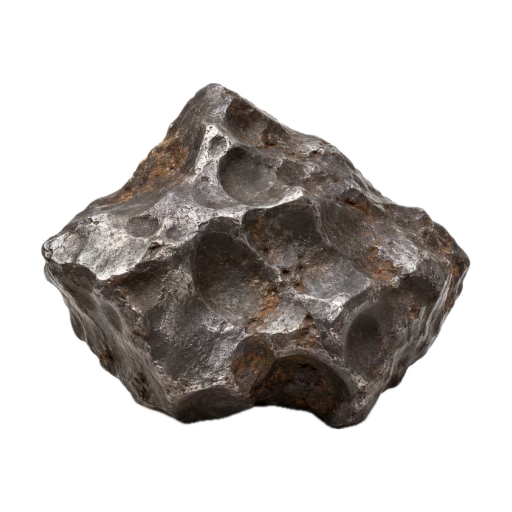
Iron meteorite
An iron meteorite is a chunk of iron-nickel metal from the core of a broken-up asteroid. It is one of the main types of meteorite.
How to identify an iron meteorite
Extremely heavy for its size, dark brown to black outside, and often covered in thumbprint-like dents. A freshly cut face is bright silver. A magnet sticks strongly, and etched slices show a crosshatch pattern.
Real or fake iron meteorite: common imitations
How much is an iron meteorite worth?
At average quality, a walnut-sized rough piece (about 113 g) is worth $170 to $290; a 1 kg rough piece, $1,000 to $1,700; an egg-sized crystal (about 375 g), $940 to $2,600.
| Specimen | Ordinary | Average | Fine |
|---|---|---|---|
| Rough piece, walnut-sizedabout 113 g | $130 to $200 | $170 to $290 | $260 to $440 |
| Rough piece, 1 kg | $750 to $1,200 | $1,000 to $1,700 | $1,500 to $2,500 |
| Crystal, egg-sizedabout 375 g | $510 to $1,300 | $940 to $2,600 | $2,200 to $6,000 |
Ordinary quality: dull, opaque or chipped. Fine quality: vivid color, clean and translucent stone.
The price depends first on authenticity: a meteorite that has been analyzed and recorded under an official name sells for far more than a doubtful stone. Next come the rarity of the type, the weight, the beauty of the piece and its story: an observed fall or a famous name is worth more. Polished slices that show Widmanstätten patterns are sought after, and rust lowers the price. Most heavy, magnetic stones people pick up are not meteorites.
These figures are orders of magnitude from Kaillou’s calculator: an estimate, not an appraisal. For a piece that looks exceptional, ask a gemologist. How the calculator works.
Where to find an iron meteorite
Anywhere, but easiest to find on bare ground such as deserts and Antarctic ice. Known sites include Campo del Cielo in Argentina, Gibeon in Namibia and Canyon Diablo in Arizona.
France has a few large iron meteorites. The one from Caille, in the Alpes-Maritimes (southeastern France), weighs about 625 kg: it was serving as a bench in front of the village church when a mineralogist spotted it in 1828. It is kept at the Muséum national d’histoire naturelle. At Saint-Aubin, in the Aube, a first fragment was found in 1968, then a 477 kg block in 2018. No law fixes the ownership of a meteorite found in France, and case law is divided: it may belong to the finder or to the landowner.
Good to know
Iron rusts. Humid air can slowly corrode specimens, so they are best stored dry.
Iron meteorite history
Meteoritic iron was shaped into beads and tools long before people could smelt iron from ore. A dagger found in the tomb of Tutankhamun was made from it.