Kaillou

Danburite
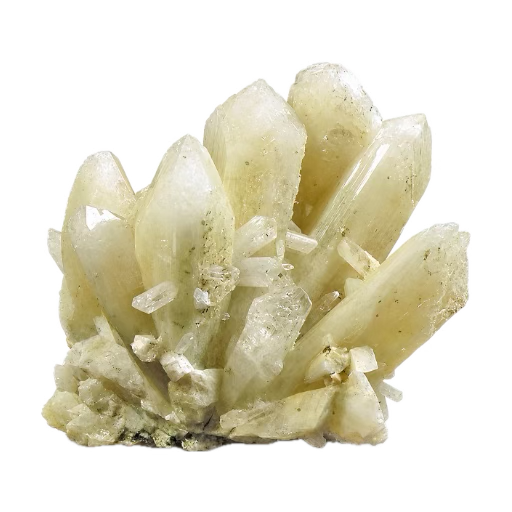
Danburite is a calcium boron silicate named for Danbury, Connecticut, where it was first found. It is usually colorless, like quartz, but can be pale yellow or brownish.
How to identify danburite
Glassy prisms with a diamond-shaped cross-section and chisel-like ends. It is hard enough to scratch glass. Cut stones are clear and brilliant.
Real or fake danburite: common imitations
How much is danburite worth?
At average quality, a walnut-sized rough piece (about 44 g) is worth $4 to $9; a 1 kg rough piece, $49 to $110; a 1-carat cut stone, $16 to $33.
| Specimen | Ordinary | Average | Fine |
|---|---|---|---|
| Rough piece, walnut-sizedabout 44 g | $2 to $5 | $4 to $9 | $7 to $16 |
| Rough piece, 1 kg | $31 to $60 | $49 to $110 | $92 to $190 |
| Crystal, egg-sizedabout 147 g | $11 to $33 | $23 to $81 | $69 to $240 |
| Cut stone, 1 carat0.2 g | $11 to $20 | $16 to $33 | $29 to $57 |
Ordinary quality: dull, opaque or chipped. Fine quality: vivid color, clean and translucent stone.
For a cut stone, clarity and color set the price: a truly colorless danburite is worth more per carat than a very pale yellow or slightly pink stone. Large clean stones are rare. Collector crystals, often from Mexico, are judged on their sharpness, intact terminations and size. Most danburites are untreated, but some Russian stones have been irradiated for their color. An opaque or broken fragment remains a curiosity.
These figures are orders of magnitude from Kaillou’s calculator: an estimate, not an appraisal. For a piece that looks exceptional, ask a gemologist. How the calculator works.
Where to find danburite
In contact metamorphic rocks and pegmatites. Mexico, Madagascar, Myanmar and Russia are known sources.
In France, danburite is extremely rare. It has been identified at Saint-Maime (Alpes-de-Haute-Provence), near old lignite workings, in rocks transformed by the natural burning of carbon-rich sediments. A study published in 2010 by the Luberon Regional Natural Park describes it as white tabular crystals, extremely rare at the site. According to this study, the commune lies within the protected perimeter of the Luberon Geological Nature Reserve: digging for samples is prohibited without authorization from the prefecture.
Danburite history
Charles Upham Shepard described it in 1839 from Danbury. It became a cut gem much later, valued for its clarity.