 Kaillou

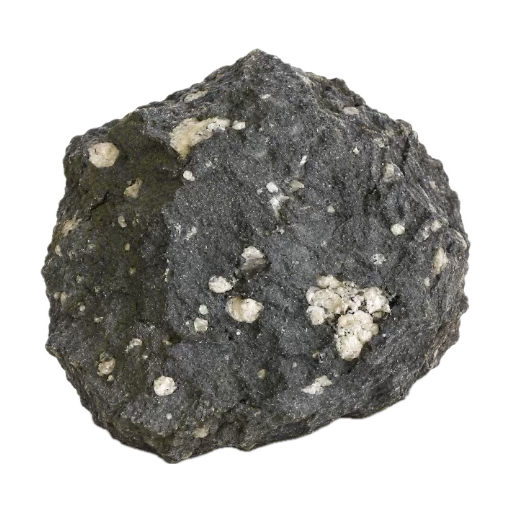
Andesite
Andesite is a fine-grained volcanic rock that sits between basalt and rhyolite in silica content. It is named after the Andes, where it is widespread.
How to identify andesite
Gray to dark gray, sometimes reddish, with a dull, fine-grained base. It often holds visible white feldspar or black hornblende crystals scattered through it. It is paler and lighter than basalt.
How much is andesite worth?
At average quality, a walnut-sized rough piece (about 38 g) is worth under $1; a 1 kg rough piece, $6 to $10.
| Specimen | Ordinary | Average | Fine |
|---|---|---|---|
| Rough piece, walnut-sizedabout 38 g | under $1 | under $1 | $1 to $2 |
| Rough piece, 1 kg | $5 to $8 | $6 to $10 | $9 to $14 |
Ordinary quality: dull, opaque or chipped. Fine quality: vivid color, clean and translucent stone.
A piece of andesite picked up from the ground finds no buyer: the prices in the table are those of specimens sold in shops. Andesite is sold mostly in bulk as road aggregate or building stone, with its price reflecting extraction and transportation costs. A collector is interested only in a remarkable piece, with large, clearly visible crystals or cavities filled with zeolites, or from a famous volcano.
These figures are orders of magnitude from Kaillou’s calculator: an estimate, not an appraisal. For a piece that looks exceptional, ask a gemologist. How the calculator works.
Where to find andesite
In volcanic arcs above subduction zones, such as the Andes, the Cascades, Japan and Indonesia.
In France, andesite is abundant mainly in the Antilles, in Guadeloupe and Martinique. Mount Pelée, in the north of Martinique, is made partly of it: its very viscous andesitic lava forms domes and produces pyroclastic flows. On May 8, 1902, one of them destroyed the town of Saint-Pierre. In mainland France, the gray volcanic rocks of the Cantal and the Mont-Dore are not true andesites but trachyandesites. In the Carladès, they were used to build the walls of houses, churches and castles.
Andesite history
The name was proposed in 1826 by German geologist Leopold von Buch. It has long served as building stone and crushed rock for roads.


