Kaillou


Stilbite
Stilbite is a series of zeolite minerals, hydrous calcium and sodium aluminum silicates. It forms in cavities and cracks of volcanic rock.
How to identify stilbite
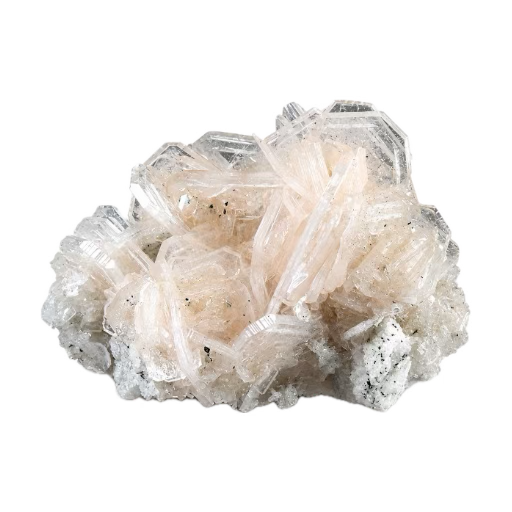
Sheaf-like or bow-tie bundles of flat crystals in white, cream, pink or orange, with a pearly shine on the faces. The crystals are translucent and light in weight. A knife scratches them.
Real or fake stilbite: common imitations
- Heulandite
- Another zeolite with coffin-shaped crystals. Stilbite grows in sheaves.
How much is stilbite worth?
At average quality, a walnut-sized rough piece (about 32 g) is worth $1 to $3; a 1 kg rough piece, $18 to $35; an egg-sized crystal (about 106 g), $7 to $22.
| Specimen | Ordinary | Average | Fine |
|---|---|---|---|
| Rough piece, walnut-sizedabout 32 g | $1 to $2 | $1 to $3 | $2 to $4 |
| Rough piece, 1 kg | $12 to $22 | $18 to $35 | $31 to $60 |
| Crystal, egg-sizedabout 106 g | $3 to $10 | $7 to $22 | $19 to $59 |
Ordinary quality: dull, opaque or chipped. Fine quality: vivid color, clean and translucent stone.
A piece of ordinary stilbite, a white crust in a rock, finds no buyer. The prices in the table are those of specimens sold by mineral dealers. Everything comes down to form: neat sheaves and bow-ties, a clear color, peach or pink, an intact pearly luster, the size of the piece. Associations with apophyllite, in basalt cavities, appeal to collectors. Soft and cleavable, it is easily damaged: a crushed sheaf loses most of its value.
These figures are orders of magnitude from Kaillou’s calculator: an estimate, not an appraisal. For a piece that looks exceptional, ask a gemologist. How the calculator works.
Where to find stilbite
In gas bubble cavities of basalt. Fine specimens come from the Deccan Traps of India, Iceland, the Faroe Islands and Nova Scotia.
In France, the story of stilbite begins in the Oisans, in the French Alps: Johann Gottfried Schreiber found crystals there in 1791, and Saint-Christophe-en-Oisans, in the Isère, is sometimes cited as one of the localities of the stilbite described by Haüy in 1796. It is also reported at Saint-Béat, in the Haute-Garonne, and in the Aure valley, in the Hautes-Pyrénées, in the Pyrenees. Part of the commune of Saint-Christophe belongs to the Écrins National Park: in the core of the park, no collecting of minerals is allowed.
Stilbite history
Stilbite was once confused with heulandite and was separated in 1818. Its name comes from a Greek word meaning to shine, after the pearly look of some crystal faces.