Kaillou


Amazonite
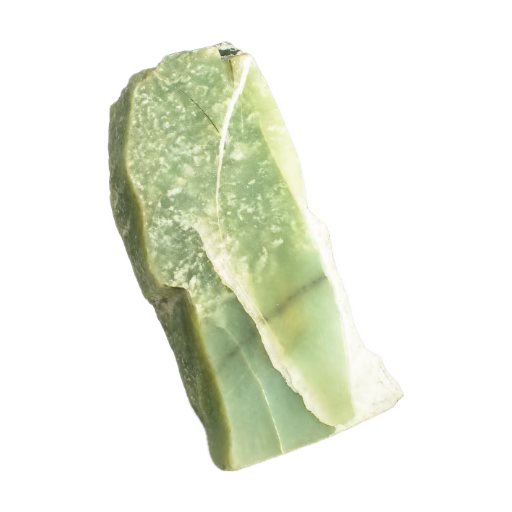
Amazonite is the green to blue-green variety of microcline, a potassium feldspar. The name refers to the Amazon River, though the link is doubtful.
How to identify amazonite
Opaque to translucent green, often with fine white streaks or a plaid-like grid. Flat, shiny faces flash where it breaks along two directions that meet at right angles. It can scratch glass only with effort.
Real or fake amazonite: common imitations
- Dyed stone
- Dyed howlite or quartz can imitate it. Color that gathers in cracks is a warning.
- Jade
- Heavier and tougher, without the white streaks and flashing flat faces.
How much is amazonite worth?
At average quality, a walnut-sized rough piece (about 38 g) is worth $1 to $4; a 1 kg rough piece, $21 to $45; an egg-sized crystal (about 128 g), $9 to $33.
| Specimen | Ordinary | Average | Fine |
|---|---|---|---|
| Rough piece, walnut-sizedabout 38 g | $1 to $2 | $1 to $4 | $2 to $6 |
| Rough piece, 1 kg | $13 to $26 | $21 to $45 | $40 to $83 |
| Crystal, egg-sizedabout 128 g | $4 to $13 | $9 to $33 | $27 to $93 |
Ordinary quality: dull, opaque or chipped. Fine quality: vivid color, clean and translucent stone.
Color decides almost everything: a vivid, even blue-green sells better than a pale, dull green. The absence of fractures matters too and, for a specimen, so do sharp crystals, sometimes paired with smoky quartz as at Pikes Peak. Most stones are sold untreated, but some are dyed, impregnated with wax or coated. The trade name “Amazon jade” is misleading. An ordinary fragment found on the ground rarely sells.
These figures are orders of magnitude from Kaillou’s calculator: an estimate, not an appraisal. For a piece that looks exceptional, ask a gemologist. How the calculator works.
Where to find amazonite
In granite pegmatites. Pikes Peak in Colorado, the Ilmen Mountains in Russia, Madagascar and Brazil are known sources.
Good to know
Its two cleavage directions make it split or chip if struck.
Amazonite history
Beads of amazonite appear in ancient Egyptian and Mesopotamian finds. No old writer mentions it, and it was only described as a mineral in the 18th century.