Kaillou

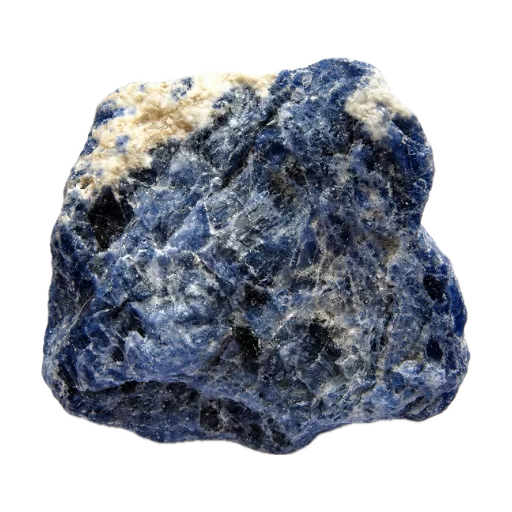
Sodalite
Sodalite is a sodium aluminum silicate containing chlorine, best known as a royal blue ornamental stone. It belongs to the same group as lazurite, the main blue mineral of lapis lazuli.
How to identify sodalite
Deep blue, often with white veins or patches, with a glassy to slightly greasy shine. Large pieces are usually opaque or translucent. It lacks the golden specks of lapis and leaves a white mark on unglazed porcelain.
Real or fake sodalite: common imitations
- Lapis lazuli
- Often with gold pyrite flecks, and it leaves a pale blue mark instead of white.
- Dyed howlite or magnesite
- Color gathers in cracks and pits, and the veins look too regular.
How much is sodalite worth?
At average quality, a walnut-sized rough piece (about 34 g) is worth $1 to $2; a 1 kg rough piece, $12 to $26; an egg-sized crystal (about 114 g), $5 to $17.
| Specimen | Ordinary | Average | Fine |
|---|---|---|---|
| Rough piece, walnut-sizedabout 34 g | $1 to $2 | $1 to $2 | $1 to $4 |
| Rough piece, 1 kg | $8 to $16 | $12 to $26 | $23 to $47 |
| Crystal, egg-sizedabout 114 g | $2 to $7 | $5 to $17 | $14 to $49 |
Ordinary quality: dull, opaque or chipped. Fine quality: vivid color, clean and translucent stone.
Color sets the price: a deep, even royal blue is worth more than a grayish blue or one heavily veined with white. Sodalite is mostly an ornamental stone, cut into cabochons, beads or carved objects. Transparent, faceted stones are rare and are primarily collectors’ gems. White sodalite dyed blue is not worth as much as natural blue. An ordinary, pale or heavily veined piece rarely resells for more than a few dollars.
These figures are orders of magnitude from Kaillou’s calculator: an estimate, not an appraisal. For a piece that looks exceptional, ask a gemologist. How the calculator works.
Where to find sodalite
In igneous rocks poor in silica, along with feldspar-like minerals. Ontario in Canada, Brazil, Namibia and India are known sources, and the first find was in Greenland.
Good to know
Fairly soft, it scratches more easily than quartz. Heat can also make it lose its color.
Sodalite history
Europeans first described it in 1811 from Greenland, but it remained a curiosity until large deposits of fine blue material were found in Ontario in 1891. Linus Pauling worked out its crystal structure in 1930.