Kaillou

Selenite
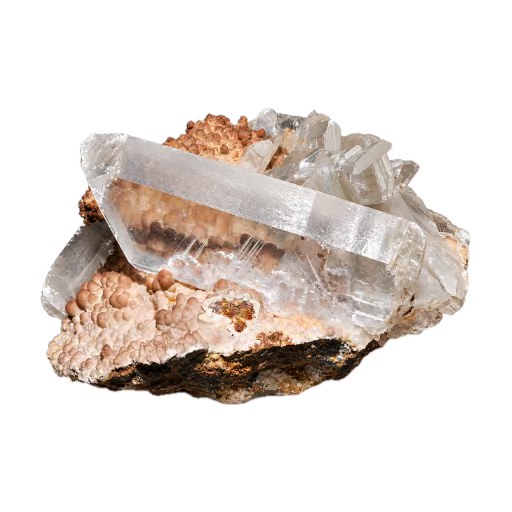
Selenite is the clear, transparent variety of gypsum. Despite the name, it contains no selenium: both words come from the Greek for the Moon.
How to identify selenite
Colorless, glassy crystals or flat blades with a pearly sheen along the flat faces. It peels into thin sheets that bend but do not spring back, and a fingernail scratches it. Some crystals form swallowtail twins.
Real or fake selenite: common imitations
- Clear calcite
- Harder, fizzes in vinegar, and breaks into slanted blocks.
- Mica
- Its thin sheets spring back when bent, while selenite sheets stay bent.
- Satin spar
- Silky, fibrous gypsum often sold as selenite, especially as carved lamps and towers. It is another variety of the same mineral.
How much is selenite worth?
At average quality, a walnut-sized rough piece (about 35 g) is worth $1 to $2; a 1 kg rough piece, $8 to $16; an egg-sized crystal (about 116 g), $3 to $11.
| Specimen | Ordinary | Average | Fine |
|---|---|---|---|
| Rough piece, walnut-sizedabout 35 g | under $1 | $1 to $2 | $1 to $2 |
| Rough piece, 1 kg | $6 to $11 | $8 to $16 | $14 to $26 |
| Crystal, egg-sizedabout 116 g | $1 to $5 | $3 to $11 | $9 to $27 |
Ordinary quality: dull, opaque or chipped. Fine quality: vivid color, clean and translucent stone.
An ordinary selenite plate finds no buyer: gypsum is one of the most widespread minerals. Only fine crystals interest collectors: clarity, size, sharp faces, arrowhead or swallowtail twins, known provenance. The lamps, wands and towers sold under this name are often satin spar, another common variety. Scratches, breaks and water marks quickly make crystals lose their appeal.
These figures are orders of magnitude from Kaillou’s calculator: an estimate, not an appraisal. For a piece that looks exceptional, ask a gemologist. How the calculator works.
Where to find selenite
In clay and evaporite beds and in caves. The Naica mine in Mexico holds the largest crystals known, and Oklahoma's Great Salt Plains is known for hourglass crystals.
In France, gypsum is abundant in the Paris Basin. At Cormeilles-en-Parisis, in the Val-d’Oise, a quarry has extracted for more than two centuries a gypsum about 40 million years old, about 26 meters thick in total. The marls caught between two masses of gypsum there are known for fine crystals with the arrowhead twin, famous in the Paris Basin. The town is home to the Musée du Plâtre (plaster museum). A working quarry remains private land.
Good to know
It dissolves slowly in water and scratches easily, so wetting or soaking damages it.
Selenite history and lore
Transparent selenite sheets mined in Spain served as window panes in ancient Rome. The name has been used for clear gypsum since at least the 15th century.
In old belief the stone grew and shrank with the phases of the Moon.