Kaillou


Libyan desert glass
Libyan desert glass is a pale yellow natural glass, almost pure silica, scattered over part of the Sahara in Libya and Egypt. It formed about 29 million years ago in an event tied to a meteorite impact or explosion.
How to identify Libyan desert glass
Translucent pale yellow to greenish-yellow pieces with a glassy shine. The outside is pitted and wind-polished, and breaks show curved, shell-like scars. Small bubbles and whitish specks are common.
Real or fake Libyan desert glass: common imitations
- Man-made glass
- Often shows mold seams and round bubbles, and the surface is not pitted by wind.
- Moldavite and Darwin glass
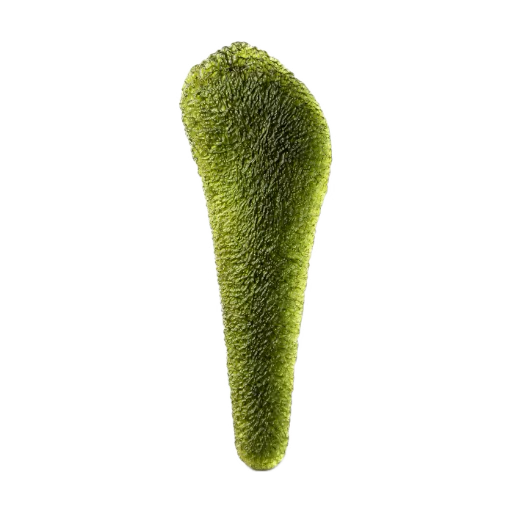
- Other impact glasses, but they are green to dark, not pale yellow.
How much is Libyan desert glass worth?
At average quality, a walnut-sized rough piece (about 33 g) is worth $33 to $60; a 1 kg rough piece, $1,000 to $1,900.
| Specimen | Ordinary | Average | Fine |
|---|---|---|---|
| Rough piece, walnut-sizedabout 33 g | $23 to $39 | $33 to $60 | $55 to $99 |
| Rough piece, 1 kg | $700 to $1,200 | $1,000 to $1,900 | $1,600 to $3,000 |
Ordinary quality: dull, opaque or chipped. Fine quality: vivid color, clean and translucent stone.
The price depends mostly on clarity and color: a transparent, clear yellow piece with almost no bubbles is worth far more than a milky chip. Next come size, a fine wind-polished shape and the absence of fresh breaks. The typical inclusions, bubbles, small white spheres of cristobalite or brown streaks, are a sign of natural origin. A molded yellow glass with a smooth surface is worth only a trinket’s price.
These figures are orders of magnitude from Kaillou’s calculator: an estimate, not an appraisal. For a piece that looks exceptional, ask a gemologist. How the calculator works.
Where to find Libyan desert glass
Only in the Great Sand Sea of eastern Libya and western Egypt, where pieces lie on the sand across a wide area.
This glass is not found in France: it comes only from the Libyan Desert. Yet the largest known piece, about 26 kg, is at the Muséum national d’histoire naturelle in Paris, which showed it in the exhibition “Météorites, entre ciel et terre” (Meteorites, between sky and earth), at the Grande Galerie de l’Évolution, in 2017 and 2018. Its first known mention is in an 1850 report by F. Fresnel, then French consul in Jeddah, and the naturalist Théodore Monod helped make it known in France.
Libyan desert glass history
Stone Age people in the region knapped it into tools in the way they did flint. A carved scarab of this glass sits in a breast ornament found in the tomb of Tutankhamun.